
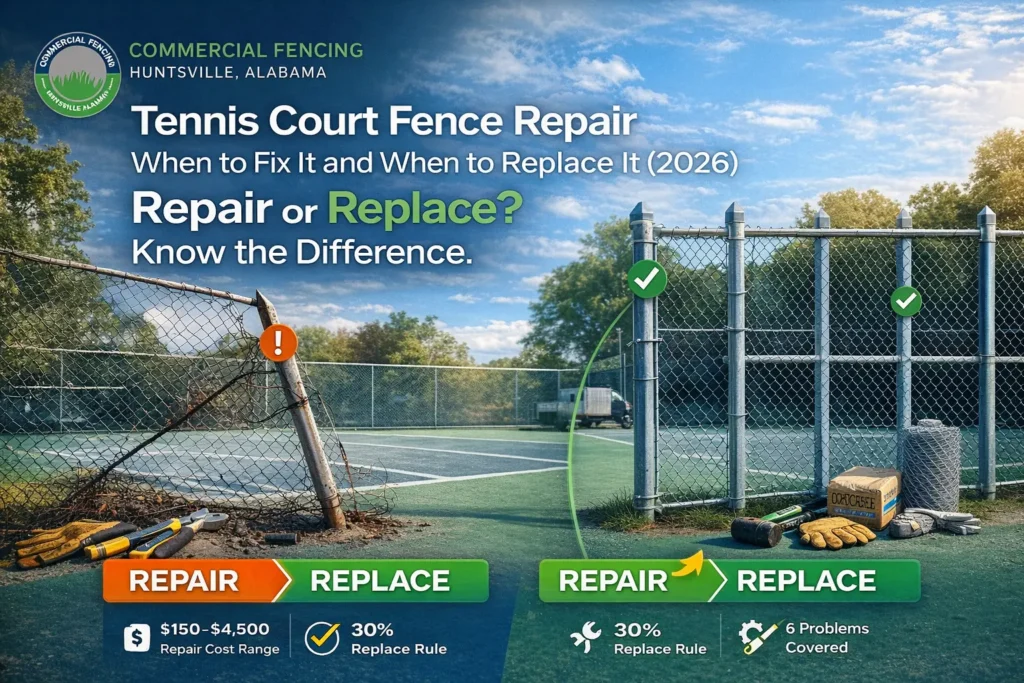
| Tennis court fence repair covers six common problems: post lean, fabric sag, rust and corrosion, gate misalignment, top rail damage, and bottom tension wire failure. Repair costs range from $150 for a single post reset to $4,500 for a full section replacement. Repair makes sense when damage covers less than 30 percent of the fence perimeter and the posts are structurally sound. Beyond that point, full replacement is almost always the better financial decision. |
A tennis court fence does not fail all at once. It gives you warnings first.
A post that leans a little more after each winter. A section of fabric that ripples when the wind picks up. A gate that catches instead of swinging clean. Most people ignore these signs until the fence fails a USTA inspection or a ball gets through during a match.
I have been repairing and replacing tennis court fences across North Alabama for over three years. The repair calls I get almost always involve problems that started small and sat too long. A $300 post repair turns into a $3,500 section replacement when the lean goes unchecked for two full seasons.
This guide covers every common repair problem I see on courts in Huntsville and the surrounding area, what each one costs, and how to know when repair stops making financial sense.
Should You Repair or Replace a Tennis Court Fence?
| QUICK ANSWER
Repair the fence if the damage covers less than 30 percent of the total perimeter and the posts are structurally sound. Replace it if more than 30 percent of the fabric has failed, multiple posts have shifted, or the fence is over 20 years old with recurring problems. A fence that needs repair in three separate sections within one season is almost always cheaper to replace in full. |
This is the question I get asked most. The answer almost always comes down to two things. How much of the fence is affected and how solid the posts still are.
A single leaning post with intact concrete around it is a repair job. Four leaning posts spread across the court with cracked footings is a replacement conversation.
Here is the framework I use on every assessment:
| Condition | Recommendation | Reason |
| Single post lean, concrete still solid | Repair | Isolated problem, straightforward fix |
| Fabric sag in one section, posts intact | Repair | Fabric is affordable to re-tension or replace |
| Surface rust on galvanized, no wire damage | Repair | Treat and coat before it spreads further |
| Gate misalignment, hinges still intact | Repair | Hardware adjustment, no major structural work |
| Multiple leaning posts across the court | Replace | Footing failure is systemic, not isolated |
| Fabric sag across more than 30% of fence | Replace | Re-tensioning buys two years at best |
| Rust through the wire in multiple sections | Replace | Structural integrity is already compromised |
| Fence over 20 years old, recurring issues | Replace | Repair costs will keep adding up each season |
If your fence checks more than two boxes in the replace column, put the repair budget toward a new install instead.
Before you budget for a full replacement, it helps to know what the full installed cost looks like. Our tennis court fence cost guide breaks down every line item, including material, labor, gates, windscreens, and permit fees specific to North Alabama.
Free Estimate for North Alabama
Not Sure If Your Fence Needs a Repair or a Full Replacement?
I will come out, look at what you have, and give you a straight answer. No pressure, no upsell! Most assessments take under 30 minutes. You will leave the call knowing exactly what the problem is and what it will cost to fix it.
Or call us at +1 256-384-3619 · Mon–Fri, 9 AM to 5 PM
What Are the Most Common Tennis Court Fence Repair Problems?
These are the six problems I repair most often on courts across Huntsville and North Alabama. Each one has a different cause, a different fix, and a different cost range.
Post Lean
A leaning post is the most common repair call I get. It almost always comes down to one of three things. The post was not set deep enough at installation. The concrete footing cracked over winter. Or the post is undersized for its position on the fence line.
Line posts on a 10-foot tennis court fence need to go at least 3 feet into the ground, set in concrete. Corner and gate posts need 4 feet minimum. When a post was set at 2 feet, which happens more than it should, it will start to lean within two to three seasons.
Post depth requirements change depending on fence height. A 12-foot competition court calls for deeper footings than a standard 10-foot recreational build. If you are not sure which height your court needs, our guide on how tall a tennis court fence should be covers the USTA and ITF requirements for each court type.
The fix depends on the footing condition. If the concrete is still intact, I can often brace and straighten the post without full removal. If the footing has cracked or heaved, the post comes out, the old concrete gets broken up, and a new post goes in at the correct depth.
Cost range: $150 to $400 per post, depending on footing condition and post size.
Fabric Sag
Fabric sag happens for three reasons. The tension bars were not tight enough at installation. The gauge is too light for the fence height. Or the bottom tension wire has failed and the fabric has lost its base anchor.
A sagging fabric section does not mean the whole fence needs replacing. If the posts are sound and the sag is in one or two bays, re-tensioning or replacing that section of fabric is a clean, affordable fix.
Fabric sag caused by the wrong wire gauge is one of the most preventable problems on a court fence. The full buyer’s guide to tennis court chain link fencing explains why 9-gauge wire is the ASTM F969 minimum for commercial courts and what happens when contractors cut corners with 11-gauge.
Cost range: $8 to $20 per linear foot for fabric replacement in a specific section.
Rust and Corrosion
North Alabama’s humidity hits galvanized chain link hard over time. Surface rust on galvanized wire shows up after 7 to 10 years in most cases. The question is whether it is surface oxidation or whether the rust has eaten through the wire itself.
Surface rust responds well to a wire brush and rust-inhibiting primer. Once the rust has eaten through the wire, that section needs full replacement. A fence with wire-through rust in multiple sections is past the point where repair makes financial sense.
Cost range: $50 to $200 for rust treatment on a localized section.
Gate Misalignment
Gates sag and misalign when the hinge posts shift or when the hinges themselves wear out. A gate that does not close properly is not just inconvenient. On a school or club court it is a safety and liability issue.
Most gate adjustments are minor. A hinge swap or a post brace fixes 80 percent of the gate calls I get. Full gate replacement is only necessary when the frame itself has bent from a direct impact.
Cost range: $150 to $350 for a gate adjustment or hinge replacement. $400 to $900 for a full gate replacement.
Top Rail Damage
The top rail takes damage from fallen branches, equipment impact, and the gradual weight of fabric that was never properly tensioned. A bent or broken top rail section throws the entire fence line out of alignment and puts extra stress on the posts at both ends of the damaged span.
Top rail sections are replaceable without touching the posts or the fabric in most cases.
Cost range: $5 to $12 per linear foot for top rail replacement.
Bottom Tension Wire Failure
The bottom tension wire keeps the fabric anchored at the base of the fence. When it snaps or stretches loose, the fabric bottom lifts and waves in the wind. This is one of the fastest repairs on a court fence and one of the most often ignored.
Cost range: $100 to $250 to re-run and tension a new bottom wire across the full court perimeter.
How Much Does Tennis Court Fence Repair Cost?
| QUICK ANSWER
Tennis court fence repair costs between $150 and $4,500, depending on the type and extent of the damage. A single post reset runs $150 to $400. A full section replacement runs $1,200 to $4,500. Most repair jobs I handle on courts in North Alabama land between $400 and $1,500 for localized damage. |
| Repair Type | Cost Range | Notes |
| Single post reset | $150 to $400 | Includes footing repair if needed |
| Fabric re-tension per bay | $100 to $300 | Posts and rail must be structurally sound |
| Fabric replacement per linear foot | $8 to $20 | Material and labor included |
| Top rail replacement per linear foot | $5 to $12 | Straightforward when posts are solid |
| Gate adjustment or hinge swap | $150 to $350 | Most common gate repair call |
| Full gate replacement | $400 to $900 | Walk gates; equipment gates price higher |
| Rust treatment, localized section | $50 to $200 | Wire brush, primer, rust-inhibiting coat |
| Bottom tension wire replacement | $100 to $250 | Full court perimeter run |
| Section replacement per 50 linear feet | $1,200 to $4,500 | Fabric, posts, rail, and all hardware |
North Alabama pricing runs 10 to 15 percent below national averages. These ranges reflect actual jobs in Huntsville and the surrounding area, not numbers pulled from a national database that has never dealt with Alabama clay soil.
These repair figures tell part of the story. If you are weighing repair against full replacement, the numbers that actually help you decide are the full installed costs for a new fence. Our 2026 tennis court fence cost guide has the full breakdown by material, height, and court size, so you can compare the two options side by side before you commit to either.
Can You Repair a Tennis Court Fence Yourself?
| QUICK ANSWER
Minor repairs like surface rust treatment, tightening loose fence ties, and re-hanging a dropped gate are manageable with basic tools. Anything involving post resets in concrete, fabric replacement on a 10-foot fence, or top rail work is a professional job. The equipment required to tension commercial-grade chain link fabric correctly is not standard homeowner gear. |
I get this question from homeowners with backyard courts more than anyone else. Here is an honest breakdown.
DIY works for: Surface rust treatment. Tightening loose fence ties. Replacing a single broken tension band or loop cap. Re-hanging a gate that has dropped off its hinges on intact posts.
DIY does not work well for: Post resets in concrete. Re-tensioning fabric on a 10 or 12-foot fence. Top rail replacement. Any repair where the structural integrity of the fence is in question.
The specific risk with DIY post work is that an improperly reset post on a 10-foot fence creates a real safety hazard. A post that leans at the top of a 10-foot run puts stress on every adjacent fitting. If it fails during play, the result is sudden and dangerous.
For any repair beyond surface-level fixes, get a professional assessment before you put money into materials.
How Long Does a Tennis Court Fence Last Before It Needs Repair?
| QUICK ANSWER
A properly installed 9-gauge galvanized tennis court fence lasts 15 to 25 years before significant repairs are needed. Vinyl-coated chain link lasts 20 to 35 years. The biggest factors are installation quality, post depth, and whether the fence was built to ASTM F969 specifications. |
The fences I get called to repair earliest are almost always ones that were not installed to spec. Posts set too shallow. Wrong gauge for the fence height. No mid-rail on a 12-foot fence. These problems show up within three to five years of installation.
A fence built correctly, with 9-gauge wire, posts at the right depth, and proper tensioning throughout, will give you 15 to 20 years with minimal attention. Add vinyl coating and that range pushes to 25 or 30 years.
A lot of premature failures trace back to specs that were wrong from day one. If you are replacing a fence and want to understand exactly what a correctly built court fence looks like before you take a single quote, the tennis court chain link fence buyer’s guide covers every ASTM F969 spec in plain English, including gauge, mesh size, post diameter, and post depth requirements.
Annual maintenance makes a real difference too. Check for post lean every spring after the ground thaws. Re-tension the bottom wire every two to three years. Treat any rust spots on galvanized fencing before they spread past the surface.
|
Serving Huntsville and North Alabama Ready to Get an Exact Number for Your Court?Every court is different. Soil conditions, fence height, existing damage, and materials all change the final price. Skip the guesswork and get a quote built around your specific court. Call +1 256-384-3619 · Mon–Fri, 9 AM to 5 PM |
Final Thoughts
A small problem on a tennis court fence almost always becomes a bigger one when you leave it alone. A leaning post is a manageable repair today. Left for two more seasons, it is a full replacement conversation.
Know the warning signs. Get an assessment before the damage spreads. And if a contractor recommends full replacement on a fence that only has one leaning post, get a second opinion before you commit.
Get three quotes. Ask each contractor to itemize labor and materials separately. And specify 9-gauge wire before you sign anything.
Frequently Asked Questions
Q1. How much does it cost to repair a tennis court fence?
Most tennis court fence repairs in North Alabama run between $400 and $1,500 for localized damage. A single post reset costs $150 to $400. Fabric replacement runs $8 to $20 per linear foot. Full section replacement covering roughly 50 linear feet, including posts, rail, and fabric, runs $1,200 to $4,500 depending on height and material type.
Q2. How do you fix a sagging chain link fence on a tennis court?
Start at the bottom tension wire. A failed tension wire is the most common cause of fabric sag at the base of the fence, and replacing it is fast and inexpensive. If the sag is higher up, the tension bars on each end of the affected section need to be reset and re-tightened. If the posts themselves have shifted, fix the posts before you touch the fabric or the sag will return.
Q3. Can you repair a chain link fence instead of replacing it?
Yes, in most cases. Isolated damage to a single section, a leaning post with a sound footing, a misaligned gate, or surface rust are all repairable. The point where repair stops making sense is when damage covers more than 30 percent of the fence perimeter or when multiple posts have failed footings. At that point, total repair cost approaches or exceeds full replacement cost.
Q4. How long does a tennis court fence last?
A 9-gauge galvanized tennis court fence lasts 15 to 25 years with proper installation and basic maintenance. Vinyl-coated chain link lasts 20 to 35 years. Fences built with undersized posts, insufficient depth, or the wrong gauge fail significantly earlier, sometimes within three to five years of the original installation.
Q5. What are the signs a tennis court fence needs repair?
The main warning signs are post lean of more than one inch from vertical, fabric sag that does not spring back under light pressure, rust that has eaten through the wire rather than sitting on the surface, a gate that no longer latches or swings clean, and a bottom tension wire that has snapped or pulled away from the posts. Each of these caught early is a straightforward repair. Left alone, each one turns into a much larger problem.
Q6. Is it worth repairing an old tennis court fence?
It depends on the age and the extent of the damage. A 15-year-old galvanized fence with a single leaning post and minor surface rust is worth repairing. A 22-year-old fence with fabric sagging across multiple sections, recurring rust, and two or more shifted posts is not. At that point, repair costs will keep compounding season after season. A new install built to ASTM F969 spec will outlast any patchwork on an old fence by a decade or more.