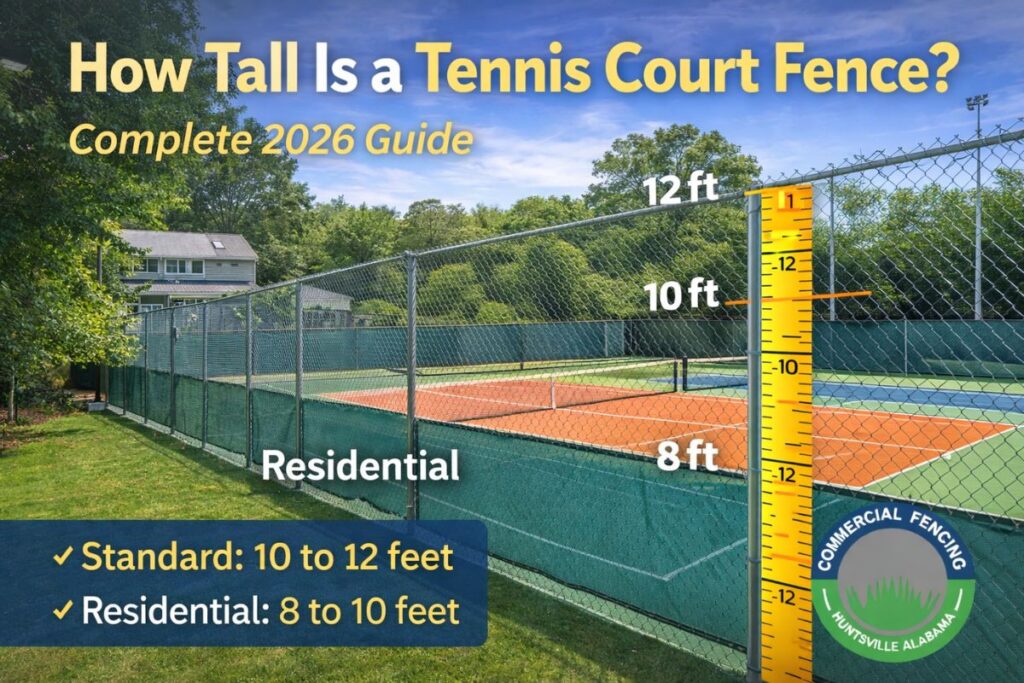
A standard tennis court fence is 10 to 12 feet tall (3.05 to 3.66 meters) for most courts. The height depends on the court type and location. Public and commercial courts typically use 10 to 12-foot fencing along baselines and back corners.
Residential courts often feature 8 to 10-foot fencing. The fence height must contain tennis balls that bounce 10 to 12 feet high during play. We install taller sections at the court ends where balls travel the highest.
Quick Answer:
- Standard Height: 10 to 12 feet (most common)
- Residential Courts: 8 to 10 feet minimum
- Professional or Tournament: 12 feet
- Baseline or Corner Sections: 10 to 12 feet (full height)
- Side Sections: 3 to 4 feet or can be open for viewing
- Clay Courts: 8 feet (lower ball bounce)
I have been installing tennis court fences across North Alabama for over three years now. During this time, I have helped dozens of homeowners, schools, and recreation departments choose the right fence height for their courts. The question I get asked most often is simple: How tall should a tennis court fence be?
The answer depends on several factors. These include whether you are building a residential or commercial court, your local regulations, and your budget. In this guide, I will share everything I have learned about tennis court fence heights. This includes standards, materials, costs, and local requirements here in Huntsville and Madison County.
Why Tennis Court Fence Height Matters
Before we dive into specific heights, let me explain why fence height is so important. Over my years of installing fences in Huntsville, I have seen what happens when courts have fences that are too short.
Ball Containment
Tennis balls can bounce 10 to 12 feet high during aggressive play. I have seen balls sail over 8 foot fences during competitive matches. This is especially true on hard courts where the ball bounces higher. When balls constantly go over the fence, players spend more time chasing them than playing tennis.
A properly sized fence keeps balls on the court. This makes the game more enjoyable for everyone. It also prevents balls from hitting cars, windows, or people in nearby areas.
Player Safety
A proper fence height protects players from running into nearby obstacles. This is critical when courts are near roads, parking lots, or other structures. The fence gives players room to chase down shots without worrying about what is beyond the court.
Players need a run-back space of 21 to 27 feet behind the baseline. The fence marks this safety zone. Without adequate fencing, players risk injury during fast-paced games.
Spectator Protection
Fences also protect people watching the game. A tennis ball traveling at 60 to 80 miles per hour can cause serious injury. The right fence height keeps everyone safe.
I have installed fences at school courts where spectators sit close to the action. In these cases, 12-foot fencing provides the best protection. Parents and fans can enjoy the game without worry.
Wind and Debris Control
Here in Huntsville, we deal with humid weather and occasional storms. A taller fence with a windscreen helps block the wind that can affect ball movement. It also prevents leaves and debris from blowing onto the court during Alabama’s storm season.
I always recommend adding windscreens to fences. They improve playability and reduce maintenance time. More on this later in the guide.
Privacy Considerations
Many homeowners want privacy when playing tennis. A 10 to 12 foot fence with windscreen creates a private space. This is especially important for residential courts in neighborhoods.
Commercial courts may also want privacy screens for training sessions or private lessons. The added height helps create this enclosed feeling.
Standard Tennis Court Fence Height Requirements
Several organizations set standards for tennis court construction. Let me break down what each one recommends.
International Tennis Federation (ITF) Standards
The ITF oversees tennis worldwide. They set guidelines for court construction and fencing. These standards ensure fair play and safety at all levels.
The ITF recommends the following specifications:
- Playing area dimensions: 78 feet by 36 feet
- Total court with clearance: 120 feet by 60 feet minimum
- Fence height: 10 to 12 feet for competition courts
- Run-back space: 21 to 27 feet behind baselines
- Side clearance: 12 feet minimum on each side
Professional tournaments follow ITF standards exactly. If you plan to host sanctioned events, your fence must meet these requirements.
United States Tennis Association (USTA) Guidelines
The USTA governs tennis in America. Their recommendations are similar to ITF standards but tailored for U.S. facilities. I reference USTA guidelines for every commercial project.
The USTA recommends:
- Competition courts: 12 feet around the entire perimeter
- Public or commercial courts: 10 feet minimum
- Recreational courts: 8 to 10 feet acceptable
- Safety clearance: At least 12 feet on sides, 18 to 21 feet behind baselines
These guidelines help ensure player safety and proper ball containment. Most insurance companies also require USTA-compliant fencing for commercial facilities.
ASTM International Standards
ASTM sets technical specifications for sports facility construction. Their standards cover fence materials, installation methods, and safety requirements.
ASTM recommends:
- Chain link fabric: 9 gauge wire minimum
- Mesh size: 1.75 inches for tennis courts
- Post spacing: 8 to 10 feet maximum
- Framework: Schedule 40 steel minimum
- Proper tensioning for stability
When I install fences, I follow ASTM standards for all material specifications. This ensures durability and safety for years to come.
Tennis Court Fence Height by Court Type
Let me walk you through the specific fence heights I recommend based on how you will use your court.
Residential Tennis Court Fencing (8 to 10 Feet)
Most of my residential clients in Huntsville choose 10-foot fencing. This height works great for backyard courts where families play casually. Eight-foot fencing can work if you have a clay court or play mainly recreational tennis. However, I usually recommend going with 10 feet. The extra two feet make a real difference in ball containment.
Things to consider for residential courts:
- Homeowner association rules in your neighborhood
- Property line setback requirements
- How the fence looks from your house
- Your budget for the project
- Whether you want privacy from neighbors
- Local building code restrictions
I have installed several backyard courts in the Huntsville area. Most homeowners are happy with 10 foot vinyl-coated chain link. It provides good ball containment without looking too imposing.
Some clients prefer variable height fencing. This means 10 to 12 feet at the baselines where balls travel highest. Then 4 to 6 feet along the sides for better viewing. This design saves money and creates a more open feel.
Public and Commercial Courts (10 to 12 Feet)
I install mostly 10 to 12 foot fencing for schools, parks, and tennis clubs in North Alabama. Public courts need taller fences because they get heavy use. Players of all skill levels use these courts. More aggressive play means balls travel higher and faster.
Municipal parks in Huntsville typically use 10 foot fencing. This meets city requirements and works well for community recreation. Country clubs and tennis facilities often go with 12 foot fencing for a more professional setup.
Schools have special considerations:
- Student safety is top priority
- Courts often sit near parking lots or buildings
- Liability concerns require proper containment
- Multiple courts need consistent fencing
I recommend 12-foot fencing for high school and college courts. The investment pays off in reduced maintenance and better safety.
Professional and Tournament Courts (12 Feet)
Competition and professional tennis courts require 12-foot fencing around the entire perimeter. This meets ITF and USTA tournament standards. There are no exceptions for sanctioned events.
Tournament courts also need:
- Full perimeter fencing with no gaps
- Proper spacing for officials and media
- Spectator safety zones
- Wind barriers at specific locations
I have helped prepare courts for regional tennis tournaments. The 12-foot requirement is strictly enforced. If you plan to host competitions, budget for this height from the start.
Variable Height Fence Design
Many of my clients choose variable height fencing to save money. This design uses different heights at different locations. Here is how it works:
- 10 to 12 feet at baselines and back corners
- 10 feet extending 20 to 30 feet along sidelines
- 3 to 4 feet or open sections at net area
- Diagonal cuts (California corners) for smooth transitions
Benefits of variable height design:
- Lower overall cost
- Better viewing from sidelines
- More attractive appearance
- Still provides excellent ball containment
This option works great for residential and some commercial courts. It does not work for tournament play where full perimeter fencing is required.
Fence Height Regulations in Huntsville, Alabama
This is where local knowledge really matters. I work with Huntsville building codes every week. Let me share what you need to know about local regulations.
Huntsville City Ordinances
Huntsville requires building permits for tennis court fence installation. The requirements vary based on your property zone. Residential zones have different height limits than commercial zones.
In the 35805 area where our business operates, most residential properties allow up to 8 feet without special approval. Fences taller than 8 feet may need a variance. Commercial properties have more flexibility with fence heights.
Important Huntsville requirements:
- Setback from property lines (usually 3 to 5 feet)
- Height limits in front yards versus backyards
- Building permit applications through City Hall
- Inspection requirements after installation
- Variance procedures for non-standard heights
At Commercial Fencing Huntsville, we handle all permit applications for our clients. This saves you time and ensures everything meets local codes. You can reach the Huntsville Building Services Department at (256) 427-5750 with questions about your specific property.
The permit process typically takes 2 to 4 weeks in Huntsville. We submit applications with detailed site plans showing fence location, height, and materials. Building officials review plans to ensure code compliance. Once approved, we schedule installation and notify the city for final inspection.
Front yard fences face stricter height limits than backyard fences. Most residential zones limit front yard fences to 4 feet. Backyard fences can go higher, often up to 8 feet without variance. Tennis courts are almost always in backyards, but you still need to verify setback requirements.
One client in South Huntsville learned about setback requirements the hard way. He started fence installation without permits. A neighbor complained, and the city stopped work. We had to redesign the fence layout to meet setback requirements. This delayed the project by six weeks and added costs. Always get permits before starting work.
Madison County Requirements
Madison County has additional regulations for properties outside city limits. These requirements can differ from Huntsville city codes.
County considerations include:
- Zoning restrictions by area
- Agricultural versus residential zoning
- Distance from roads and easements
- Environmental impact assessments
- Permit fees and timelines
We work throughout Madison County. I know which areas have stricter requirements. This helps us plan projects correctly from the start. County properties often have more flexibility with fence heights. Agricultural zoning rarely restricts fence heights, as long as setbacks are maintained.
One rural property owner in Madison County wanted a tennis court on his 10-acre property. County regulations were minimal. We could position the fence anywhere that met basic setback requirements. This flexibility allowed us to optimize the court location for sun exposure and drainage.
County permit fees differ from city fees. Expect to pay $50 to $150 for a tennis court fence permit in Madison County. The exact fee depends on project value and fence length. County inspections may take longer to schedule than city inspections due to fewer inspectors covering larger areas.
Working With Local Authorities
Getting permits approved quickly requires the right approach. Here is what I do for every project:
- Research zoning requirements before designing the fence
- Submit complete applications with all required documents
- Include detailed site plans and specifications
- Schedule inspections promptly after installation
- Maintain good relationships with building inspectors
This process usually takes 2 to 4 weeks in Huntsville. Planning ahead prevents delays and extra costs. I have developed relationships with local building officials over my three years in business. This helps move projects through the approval process smoothly.
Complete applications get approved faster. Include everything the city needs: site plans, fence specifications, material lists, and contractor information. Incomplete applications get rejected, causing delays. I prepare professional application packages that rarely need revisions.
Building inspectors appreciate contractors who follow codes. When inspectors arrive for final inspection, they expect to see exactly what was approved in the plans. Surprises cause problems. We install exactly what we show in our plans, making inspections smooth.
One benefit of using Commercial Fencing Huntsville is our code knowledge. We stay current on all local regulations. When codes change, we update our procedures immediately. This protects our clients from compliance issues.
Tennis Court Fence Materials and Specifications
The material you choose affects durability, appearance, and cost. Let me explain the most common options.
Chain Link Fencing (Most Common)
Chain link is by far the most popular tennis court fencing material. About 90 percent of my installations use chain link. It offers the best combination of cost, durability, and performance.
Fabric specifications:
- Mesh size: 1.75 inches (tennis ball cannot fit through)
- Wire gauge: 9 gauge minimum (thicker is stronger)
- Coating options: Galvanized, vinyl-coated, or both
Framework components:
- Terminal posts: 3 inch diameter
- Line posts: 2.5 inch diameter
- Top rail: 1.66 inch diameter
- All posts should be scheduled 40 steel
Color options:
- Black (most popular for tennis courts)
- Green (traditional choice)
- Galvanized silver (budget option)
- Brown or beige (blends with landscapes)
I recommend black vinyl-coated chain link for most tennis courts. The black color provides excellent ball contrast. Players can track the ball more easily against a dark background. Vinyl coating also protects the steel from rust and weather damage.
Chain link works well because it allows airflow. Unlike solid fencing, chain link lets wind pass through. This reduces wind load on the fence structure. Less wind pressure means fewer problems with posts leaning or fabric sagging.
The 9 gauge wire specification matters more than most people realize. Cheaper fencing uses 11-gauge wire, which is thinner and weaker. Nine-gauge wire lasts significantly longer and resists damage better. One client wanted to save money with 11-gauge fencing. I showed him a 10 year old 11-gauge fence with rust and sagging. He chose 9 gauge and has been happy with the decision.
Post diameter affects fence stability. Three inch terminal posts at corners and gates provide superior strength. Smaller posts can lean under tension. Line posts at 2.5 inches provide good support between terminals. These sizes create a fence that stays tight and straight for decades.
Fencing Material Comparison Table
| Material | Cost per Linear Foot | Durability (Years) | Maintenance | Best For |
| Chain Link (Galvanized) | $10 to $25 | 15 to 20 | Low | Budget-conscious projects |
| Chain Link (Vinyl-Coated) | $15 to $40 | 20 to 30 | Very Low | Most applications, best value |
| Welded Wire | $20 to $45 | 25 to 35 | Low | Premium appearance |
| Wood Frame with Wire | $30 to $60 | 10 to 15 | Medium to High | Residential aesthetic appeal |
| Vinyl Fencing | $25 to $45 | 20 to 25 | Very Low | Modern look, low maintenance |
Vinyl-Coated versus Galvanized
This is a common question I get. The answer depends on your budget and priorities.
Galvanized chain link:
- Lower initial cost ($10 to $25 per foot)
- Basic protection from rust
- Silver color shows dirt more
- Lifespan: 15 to 20 years
- May rust in humid climates
Vinyl-coated chain link:
- Higher upfront cost ($15 to $40 per foot)
- Superior rust protection
- Color options available
- Lifespan: 20 to 30 years
- Better appearance throughout life
For most clients, I recommend vinyl coating. The extra cost is worth the added lifespan and appearance. Your fence will look better longer. In Huntsville’s humid climate, galvanized fencing can show rust within five years. Vinyl-coated fencing resists rust for decades.
The cost difference is not as large as it seems initially. Spread over the fence’s lifespan, vinyl coating costs very little extra per year. Galvanized fencing may last 15 years. Vinyl-coated can last 30 years. You get twice the lifespan for about 50 percent more upfront cost.
I installed galvanized fencing at a park in 2020. By 2023, rust spots were appearing. The city is already budgeting for replacement. A nearby park that chose vinyl-coated fencing in 2015 still looks great. That eight year old fence has no rust and minimal fading.
Color choice matters for vinyl coating. Black provides the best ball visibility. Green looks traditional. Brown or beige blends with natural settings. The color is baked into the vinyl, so it does not chip or peel like paint.
Welded Wire Fencing
Welded wire offers a cleaner appearance than chain link. The vertical and horizontal wires create a grid pattern. This looks more modern and professional.
Benefits of welded wire:
- Very strong and rigid
- Self-supporting panels
- Minimal sagging over time
- Premium appearance
- Excellent ball visibility
Drawbacks:
- Higher cost than chain link (30 to 50 percent more)
- Fewer color options
- More difficult to repair if damaged
- Requires precise installation
- Less common means fewer contractors experienced with it
I install welded wire for high-end residential and commercial projects. The cost is typically 30 to 50 percent more than chain link. Clients choose it for appearance. The grid pattern looks crisp and professional.
Welded wire fencing uses thicker wire than chain link. The welds create rigid panels that maintain shape well. These panels mount to posts, creating a fence that needs minimal tensioning. Chain link requires careful tensioning during installation. Welded wire does not.
One disadvantage is repair difficulty. If a panel gets damaged, you typically replace the entire panel. Chain link allows section repairs. For tennis courts, damage is rare. Properly installed fencing lasts for decades without issues.
A tennis club in south Huntsville chose welded wire for their courts. The owner wanted a premium look to match their upscale facility. Three years later, the fencing still looks perfect. Maintenance has been zero except for occasional cleaning.
Wood Frame with Wire Mesh
Some residential clients want wood posts with wire fencing. This creates a more traditional look that blends with landscaping.
This option works well for:
- Upscale residential courts
- Properties with existing wood fencing
- Areas with specific aesthetic requirements
- Custom height transitions
Keep in mind that wood requires more maintenance. Posts need sealing or staining every few years. Hardware can rust if not properly treated. Wood posts also have shorter lifespans than steel posts. Expect 10 to 15 years before wood posts need replacement.
The combination of wood posts and wire mesh offers unique aesthetics. Some homeowners love the natural look. Wood posts can be stained to match home exteriors or existing fences. This creates visual harmony across the property.
I recommend using pressure-treated posts rated for ground contact. Cedar and redwood naturally resist rot. Whatever wood you choose, proper sealing is critical. Huntsville’s humidity accelerates wood decay. Plan for maintenance every 2 to 3 years.
One client in Hampton Cove built a beautiful court with cedar posts and black vinyl-coated mesh. The cedar posts complemented their home’s natural wood siding. They budget $200 per year for wood maintenance. The aesthetic value justifies the extra cost and effort.
Vinyl Fencing
Solid vinyl fencing is rare for tennis courts. It blocks airflow and creates wind pressure on the fence structure. However, vinyl-coated chain link or vinyl posts are popular.
Vinyl benefits:
- Will not rust or rot
- Low maintenance requirements
- Color choices available
- Long lifespan (20 to 25 years)
- Never needs painting
I use vinyl posts for some residential projects. They work well in areas with high humidity or near sprinklers. Vinyl posts cost more than steel posts but require zero maintenance. Some clients prefer this trade-off.
Solid vinyl panels block wind too much for tennis courts. Wind pressure can damage the fence structure. Chain link allows wind to pass through, reducing pressure. For tennis courts, vinyl coating on chain link provides the best balance.
Vinyl technology has improved significantly in recent years. Early vinyl fencing faded quickly in sun. Modern vinyl resists UV damage much better. Expect minimal fading over 20 to 25 years. Some manufacturers offer fade warranties.
Cost to Install Tennis Court Fencing in Huntsville
Budget is always a key consideration. Let me break down typical costs based on my projects in North Alabama.
Material Cost Breakdown
Fencing materials range widely based on type and quality. Here are typical prices per linear foot for 10 foot fencing:
| Material Type | Cost per Linear Foot | Includes |
| Galvanized Chain Link (8 ft) | $10 to $15 | Fabric, posts, top rail, hardware |
| Galvanized Chain Link (10 ft) | $15 to $20 | Fabric, posts, top rail, hardware |
| Galvanized Chain Link (12 ft) | $20 to $25 | Fabric, posts, top rail, hardware |
| Black Vinyl-Coated (8 ft) | $15 to $25 | Fabric, posts, top rail, hardware |
| Black Vinyl-Coated (10 ft) | $20 to $30 | Fabric, posts, top rail, hardware |
| Black Vinyl-Coated (12 ft) | $25 to $40 | Fabric, posts, top rail, hardware |
| Welded Wire (8 ft) | $20 to $30 | Panels, posts, hardware |
| Welded Wire (10 ft) | $25 to $35 | Panels, posts, hardware |
| Welded Wire (12 ft) | $30 to $45 | Panels, posts, hardware |
Additional Fencing Component Costs
| Component | Cost Range | Notes |
| Single Walk Gate (4 ft wide) | $200 to $350 | Standard residential |
| Double Gate (8 to 10 ft wide) | $400 to $600 | For equipment access |
| Premium Self-Closing Gate | $350 to $500 | Automatic closing hardware |
| Concrete per Post | $15 to $25 | 80 lb bag covers 1 post |
| Post Caps | $3 to $8 each | Protects post tops |
| Tension Wire | $0.50 to $1 per foot | Bottom support wire |
| Privacy Slats | $1 to $2 per foot | Alternative to windscreen |
Installation Labor Costs in Huntsville
Professional installation adds significant cost but ensures proper setup. Labor rates in Huntsville average $15 to $25 per linear foot for 10-foot fencing.
Installation includes:
- Site measurement and layout
- Post hole digging (manual or machine)
- Concrete mixing and setting
- Framework assembly and alignment
- Fabric installation and tensioning
- Gate installation and adjustment
- Final inspection and cleanup
Total installation time for a standard court is 2 to 5 days. Weather and site conditions affect the timeline. Rocky soil requires more time for post holes. Level ground installs faster than sloped terrain.
Labor costs vary based on complexity:
| Installation Type | Labor Cost per Linear Foot | Timeline |
| Standard (level ground, good soil) | $15 to $20 | 2 to 3 days |
| Moderate (slight slope, average soil) | $18 to $23 | 3 to 4 days |
| Difficult (steep slope, rocky soil) | $22 to $28 | 4 to 5 days |
| Premium (custom heights, special features) | $25 to $35 | 5 to 7 days |
I charge $18 per linear foot for standard installations in Huntsville. This includes all labor, equipment, and cleanup. Complex sites cost more due to extra time and effort.
Total Project Cost Estimates
A standard tennis court measures about 60 feet by 120 feet. The perimeter is roughly 360 linear feet. Here are typical total costs:
| Project Type | Materials | Labor | Total Cost | Fence Specs |
| Budget Option | $3,600 to $5,400 | $5,400 to $7,200 | $9,000 to $12,600 | 8 ft galvanized |
| Standard Residential | $5,400 to $7,200 | $5,400 to $7,200 | $10,800 to $14,400 | 10 ft galvanized |
| Mid-Range Quality | $7,200 to $10,800 | $5,400 to $7,200 | $12,600 to $18,000 | 10 ft vinyl-coated |
| Premium Residential | $9,000 to $14,400 | $5,400 to $7,200 | $14,400 to $21,600 | 12 ft vinyl-coated |
| Commercial Grade | $10,800 to $16,200 | $6,300 to $9,000 | $17,100 to $25,200 | 12 ft premium materials |
These estimates are for North Alabama. Costs vary based on specific site conditions and material choices. Gates, windscreens, and special features add to the base cost.
I provide detailed written estimates for every project. This helps you understand exactly what you are paying for. My estimates itemize materials, labor, and any additional features. No hidden fees or surprise charges.
Site Factors That Affect Cost
Several things can increase or decrease your project cost:
Soil Conditions: – Normal soil: Standard pricing – Rocky soil: Add 15 to 25 percent (requires special equipment) – Sandy soil: May need deeper footings (add 10 to 15 percent) – Clay soil: Standard pricing but slower digging
Terrain Factors: – Level ground: Standard pricing – Slight slope (up to 5 degrees): Add 10 percent – Moderate slope (5 to 10 degrees): Add 20 to 30 percent – Steep slope (over 10 degrees): Add 35 to 50 percent
Access Issues: – Direct road access: Standard pricing – Limited access: Add 10 to 20 percent – No equipment access: Add 25 to 40 percent (hand digging required) – Long distance from road: Add $1 to $2 per foot
Project Features: – Standard single gate: Included in estimate – Multiple gates: Add $200 to $500 per gate – Custom height variations: Add 10 to 15 percent – Windscreen installation: Add $2 to $5 per linear foot – Rush timeline: Add 15 to 25 percent
At Commercial Fencing Huntsville, we provide detailed written estimates. This helps you understand exactly what you are paying for. Call us at +1 256-384-3619 for a free quote.
DIY versus Professional Installation
Some homeowners ask about installing a fence themselves. This can save money on labor. However, tennis court fencing requires specialized skills.
Challenges of DIY installation:
- Maintaining proper tension on fabric (critical for appearance and longevity)
- Setting posts perfectly level and aligned
- Dealing with hard soil or rock
- Installing gates that function smoothly
- Meeting code requirements
- Achieve professional appearance
Tools needed for DIY:
- Post hole digger or power auger ($50 to $400)
- Concrete mixer ($150 to $300)
- Fence stretcher ($100 to $200)
- Level and measuring tools ($50 to $100)
- Come-along or fence puller ($40 to $80)
- Various hand tools ($100)
I estimate DIY installation takes 40 to 60 hours for a full court. That assumes you have some fencing experience. Mistakes can be costly to fix. One homeowner tried DIY installation and gave up after three weekends. He called me to finish the job. The repairs and completion cost more than professional installation would have originally.
Proper tensioning is the hardest part of DIY installation. Chain link must be stretched tight for good appearance and performance. Too loose and it sags. Too tight and you can damage posts or fabric. Professional installers know exactly how much tension to apply.
For most clients, professional installation makes sense. We complete the work faster and guarantee it meets all codes. You get a warranty on materials and workmanship. The peace of mind is worth the labor cost.
When DIY Makes Sense
DIY installation might work if:
- You have installed chain link fencing before
- You have or can rent the necessary tools
- You have friends or family to help
- Your timeline is flexible (6 to 8 weekends)
- Your site has good soil and level ground
- You enjoy hands-on projects
Even with DIY, consider hiring professionals for:
- Post hole digging in rocky soil ($500 to $1,000)
- Concrete work ($300 to $600)
- Final tension adjustment ($200 to $400)
- Gate installation ($150 to $300)
Partial professional help can make DIY projects more successful. I have worked with several homeowners who did most of the work themselves but hired us for critical steps.
Tennis Court Windscreen Installation
Windscreens are fabric panels attached to tennis court fencing. They provide several important benefits.
Why Install Windscreens
I recommend windscreens for almost every tennis court. Here is why:
Wind Reduction: Wind affects tennis ball flight significantly. Even a 10 mile per hour breeze can change ball trajectory by several inches. This frustrates players trying to improve their game. Windscreens block 50 to 70 percent of wind, depending on material and installation.
I installed windscreens at a Huntsville tennis club last year. Players immediately noticed the difference. One coach told me his students could finally practice consistently. Wind no longer pushed balls off course unpredictably.
Improved Ball Visibility: A solid background helps players track the ball better. Without windscreen, players see cars, buildings, trees, and movement behind the fence. These visual distractions make it harder to focus on the ball.
Black or dark green windscreens create excellent contrast. White or yellow tennis balls show up clearly against dark backgrounds. This helps players react faster and improves their game.
Privacy and Reduced Distractions: Many players appreciate privacy during practice. Windscreens block views from outside the court. This creates a focused environment for training.
One tennis instructor in Madison specifically requested windscreens for privacy during lessons. Students learn better without external distractions. The windscreens also reduce noise from nearby roads.
Sun Glare Reduction: Chain link fencing can create glare in bright sun. The metal reflects light into players’ eyes. Windscreens eliminate this problem. The fabric absorbs light instead of reflecting it.
Morning and evening sun can be especially problematic. Low-angle sunlight shines directly through chain link. Windscreens block this light, making play more comfortable during sunrise and sunset hours.
Professional Appearance: Courts with windscreens look more professional. The uniform color creates a finished appearance. Many facilities use custom-printed windscreens with logos or sponsor names.
Windscreen Height Options
Windscreens come in different heights to match your fence. Common sizes include:
| Windscreen Height | Best For | Coverage | Cost per Linear Foot |
| 6 foot | 8 to 10 ft fences | Centered, leaves top and bottom open | $1.50 to $2.50 |
| 8 foot | 10 to 12 ft fences | Leaves 12-24 inches at top or bottom | $1.75 to $3.00 |
| 9 foot | 10 to 12 ft fences | Most popular, leaves 12 inches at bottom | $1.89 to $3.49 |
| 10 foot | 12 ft fences | Nearly full coverage | $2.25 to $3.99 |
| Custom | Any fence height | Specified coverage | $2.50 to $4.50 |
I typically install 9-foot windscreens on 10-foot fences. This provides good coverage while allowing some airflow at the bottom. The opening also makes it easier to clean under the fence. Leaves and debris do not accumulate against the windscreen.
The 12-inch gap at the bottom serves multiple purposes. It allows water drainage during rain. It permits air circulation, reducing wind pressure on the fence. It also makes mowing and trimming easier around the fence perimeter.
Some clients want full coverage for maximum privacy. Ten-foot windscreens on 12-foot fences leave only 2 feet of open fence at the top. This blocks most views while still allowing some ventilation. Full coverage costs more but provides the most privacy.
For very windy areas, I recommend 6 or 8-foot windscreens. These allow more wind to pass over and under the fabric. This reduces wind pressure on the fence structure. Less pressure means longer fence life and fewer maintenance issues.
Windscreen Materials
Quality matters with windscreens. Cheap materials fade and tear quickly in the Alabama sun.
| Material Type | Opacity | UV Protection | Lifespan | Cost per Linear Foot |
| Polypropylene (Budget) | 75 to 85% | Moderate | 5 to 7 years | $1.50 to $2.50 |
| Vinyl-Coated Polyester (Standard) | 85 to 95% | Good | 7 to 10 years | $1.89 to $3.49 |
| Vinyl-Coated Polyester (Premium) | 95 to 98% | Excellent | 10 to 12 years | $2.50 to $4.50 |
| Open Mesh | 60 to 70% | Good | 8 to 10 years | $1.75 to $3.00 |
| Custom Printed | 90 to 95% | Excellent | 7 to 10 years | $5.99 to $7.99 |
I recommend vinyl-coated polyester for most installations. The higher upfront cost pays off in durability and appearance. This material resists fading better than polypropylene. It also handles wind stress without tearing.
Open mesh windscreens allow more airflow than closed fabric. Use these in very windy locations. The open mesh blocks about 60 percent of wind while letting the rest pass through. This reduces pressure on the fence structure.
Closed mesh windscreens block 85 to 95 percent of wind. They provide better privacy and ball visibility. Use these for most tennis court applications. The slight increase in wind pressure is manageable with proper fence installation.
UV protection varies by material quality. Premium materials include UV inhibitors that prevent fading and degradation. Cheaper materials fade noticeably within two years. I have seen cheap windscreens become brittle and tear after just three years.
One client chose budget windscreens to save money. After four years, they were badly faded and torn in several places. He replaced them with premium materials. The new windscreens cost more initially but will last twice as long.
Windscreen Colors and Aesthetics
Color choice affects both function and aesthetics. Here are the most popular options:
| Color | Benefits | Drawbacks | Best For |
| Black | Best ball visibility, modern look | Shows dust and pollen | Competitive play, clubs |
| Dark Green | Traditional, blends with landscaping | Slight visibility compromise | Residential, parks |
| Hunter Green | Professional appearance | Can show fading | Commercial facilities |
| Royal Blue | School colors, vibrant | Less ball contrast | Schools, recreation centers |
| Maroon/Burgundy | Unique, school colors | Limited availability | Schools, special projects |
| Custom Colors | Match branding | Higher cost, longer lead time | High-end facilities |
Black windscreens provide the best ball visibility. The dark background makes white or yellow tennis balls stand out perfectly. Professional players prefer black windscreens for this reason.
Green windscreens look traditional. This color has been used on tennis courts for decades. Green blends well with grass, trees, and natural landscaping. Many homeowners choose green to minimize visual impact.
Blue windscreens work great for schools. Many schools use blue as a primary color. Blue provides decent ball visibility while matching school branding. I have installed blue windscreens at several Madison County schools.
Custom-printed windscreens cost significantly more. Expect to pay $5.99 to $7.99 per linear foot for printing. This includes setup charges and design work. Tennis clubs use printed windscreens to display sponsor logos or facility names. The professional appearance can justify the extra cost.
Windscreen Installation Cost
Windscreen adds to your overall fence cost. Here are typical prices:
| Windscreen Type | Material Cost per Foot | Installation Labor per Foot | Total Cost per Foot |
| Basic Polypropylene | $1.50 to $2.50 | $1.00 to $1.50 | $2.50 to $4.00 |
| Standard Vinyl-Coated | $1.89 to $3.49 | $1.00 to $1.50 | $2.89 to $4.99 |
| Premium Vinyl-Coated | $2.50 to $4.50 | $1.00 to $1.50 | $3.50 to $6.00 |
| Custom Printed | $5.99 to $7.99 | $1.50 to $2.00 | $7.49 to $9.99 |
For a 360-foot court perimeter, expect to spend:
- Basic windscreen: $900 to $1,440
- Standard windscreen: $1,040 to $1,796
- Premium windscreen: $1,260 to $2,160
- Custom printed: $2,696 to $3,596
Attachment supplies add $50 to $150 total:
- Zip ties or lacing: $30 to $60
- Clips or grommets: $40 to $80
- Tensioning supplies: $20 to $40
Installation labor takes 4 to 8 hours for a full court. I charge $350 to $540 for windscreen installation on a standard court. This includes all attachment hardware and proper tensioning.
Windscreen installation requires attention to detail. The fabric must hang straight and tight. Proper tensioning prevents sagging and extends windscreen life. I use a combination of zip ties and lacing for secure attachment.
The bottom of the windscreen should be 6 to 12 inches above ground. This prevents moisture wicking and allows drainage. The top attaches to the top rail or fence fabric. Some installers attach windscreens every 12 inches. I prefer every 8 to 10 inches for better wind resistance.
Tennis Court versus Pickleball Court Fence Height
Many clients ask about the differences between tennis and pickleball court fencing. Let me explain.
Court Size and Ball Characteristics Comparison
| Feature | Tennis Court | Pickleball Court |
| Playing Area | 78 feet x 36 feet | 44 feet x 20 feet |
| Total Court Size | 120 feet x 60 feet | 64 feet x 34 feet |
| Ball Weight | 2 ounces | 0.9 ounces |
| Ball Size | 2.5 to 2.7 inches | 2.87 to 2.97 inches |
| Maximum Ball Height | 10 to 12 feet | 6 to 8 feet |
| Typical Fence Height | 10 to 12 feet | 8 to 10 feet |
| Minimum Recommended Height | 8 feet | 6 feet |
Pickleball is a growing sport. Courts are smaller than tennis courts. This affects fencing requirements. Pickleballs are lighter and do not bounce as high as tennis balls.
Tennis balls bounce 10 to 12 feet high on hard courts. Pickleballs typically bounce 6 to 8 feet high. This lower bounce means pickleball needs less fence height. However, many facilities use 10-foot fencing for both sports.
The lighter pickleball weight affects how it travels. Strong wind affects pickleballs more than tennis balls. Windscreens help more with pickleball than tennis. I always recommend windscreens for dedicated pickleball courts.
Multi-Use Court Considerations
Some facilities convert tennis courts to pickleball courts. You can fit four pickleball courts inside one tennis court. The existing 10-foot tennis fence works fine for pickleball.
If building new for both sports:
- Use 10-foot fencing minimum
- Meets requirements for both games
- Allows future conversion flexibility
- Better long-term investment
- Provides adequate containment for both balls
I have helped several clients set up multi-use courts. The 10-foot height provides flexibility for different sports. Some facilities stripe courts for both tennis and pickleball. The fencing works equally well for both games.
One recreation center in Huntsville built four pickleball courts where a tennis court used to be. They kept the existing 10-foot fencing. Players are happy with the setup. The fence contains pickleballs perfectly, even during aggressive play.
Pickleball-Specific Fencing Considerations
If building dedicated pickleball courts, you have more options:
Eight Foot Fencing: Adequate for recreational pickleball. Lower cost than 10-foot fencing. Works well for backyard courts. May have issues with very aggressive play.
Ten Foot Fencing: Recommended for most pickleball courts. Handles all skill levels. Allows future use flexibility. Professional appearance. Better ball containment during tournaments.
Fence Positioning: Pickleball needs less run-back space. Ten feet behind the baseline is adequate. Sides need 8 to 10 feet of clearance. This smaller footprint fits more courts in less space.
Windscreens: More critical for pickleball than tennis. Lighter balls blow off course more easily. Windscreens improve play consistency. Also help with ball visibility.
I installed fencing for a dedicated pickleball facility last year. They chose 10-foot vinyl-coated fencing with windscreens. Eight courts fit in the space where four tennis courts would go. The 10-foot height handles all levels of play without issues.
How to Choose the Right Tennis Court Fence Height
Let me give you a decision framework based on my experience.
Court Usage Considerations
Think about who will use the court and how often:
| Usage Type | Recommended Height | Rationale |
| Professional or Competitive Play | 12 feet | Meets tournament standards, handles hardest hits |
| High School or College Tennis | 12 feet | Safety priority, liability protection, heavy use |
| Recreational Adult Play | 10 feet | Adequate containment, cost effective |
| Family or Casual Play | 8 to 10 feet | Sufficient for recreational use |
| Children or Beginners | 8 feet | Lower bounces from slower play |
| Practice or Training Only | 8 to 10 feet | Focus on skill development, lower intensity |
The more aggressive the play, the higher the fence needed. Tournament players hit harder and generate higher ball bounces. Recreational players play at moderate speeds. Children and beginners hit softer, which creates lower bounces.
One client built a court specifically for his kids to learn tennis. We installed 8-foot fencing because the children were young. He plans to upgrade to 10 feet when they get older and play more aggressively.
Court Surface Type
The playing surface affects how high balls bounce:
| Surface Type | Bounce Characteristics | Recommended Height | Notes |
| Hard Court (Concrete) | Highest bounce | 10 to 12 feet | Most common surface, requires taller fence |
| Hard Court (Asphalt) | High bounce | 10 to 12 feet | Similar to concrete |
| Cushioned Acrylic | Medium-high bounce | 10 feet | Slightly lower than bare hard court |
| Clay Court | Medium bounce | 8 to 10 feet | Softer surface absorbs energy |
| Grass Court | Low bounce | 8 to 10 feet | Rare for new construction |
| Synthetic Turf | Medium bounce | 10 feet | Growing in popularity |
Most courts in Huntsville use hard surfaces. Concrete and asphalt are durable and low-maintenance. These surfaces create the highest bounces, requiring 10 to 12-foot fencing.
Clay courts are less common due to maintenance requirements. Clay absorbs impact energy, creating lower bounces. Eight-foot fencing works adequately for clay courts. However, I still recommend 10 feet for maximum containment.
Grass courts are extremely rare. They require constant maintenance and work best in cooler, wetter climates. Alabama’s hot, humid summers make grass courts impractical. The few grass courts I have seen use 8 to 10-foot fencing.
Location and Environmental Factors
Your court location affects fence height needs:
| Location Factor | Impact on Height | Recommendation |
| Near Roads | Safety critical | 12 feet minimum |
| Near Buildings | Ball protection needed | 10 to 12 feet |
| Near Property Lines | Neighbor relations | 10 to 12 feet with windscreen |
| Open Field | Wind exposure high | 10 to 12 feet with windscreen |
| Wooded Area | Wind protection natural | 8 to 10 feet adequate |
| Windy Hilltop | Wind stress significant | 10 feet with reinforced posts |
| Multi-Court Facility | Consistency important | Match all courts, usually 10-12 feet |
Courts near roads need maximum height for safety. Twelve-foot fencing prevents balls from reaching traffic. This protects both players and motorists. I always recommend 12 feet for courts within 50 feet of roads.
Windy locations benefit from taller fences with windscreens. The combination blocks wind and improves playability. One court I installed sits on a hilltop with constant wind. We used 12-foot fencing with 10-foot windscreens. Wind reduction made the court usable year-round.
Private backyard courts have fewer constraints. Eight to 10 feet often works well. Consider how the fence looks from your house. A 12 foot fence can feel imposing in a residential backyard. Variable height designs help balance function and aesthetics.
Budget Considerations
Be realistic about what you can afford:
| Budget Level | Fence Option | Height | Approximate Cost (360 ft perimeter) |
| Tight Budget | Galvanized chain link | 8 feet | $9,000 to $12,000 |
| Moderate Budget | Vinyl-coated chain link | 10 feet | $12,600 to $18,000 |
| Standard Budget | Vinyl-coated with windscreen | 10 feet | $14,000 to $20,000 |
| Premium Budget | Vinyl-coated with windscreen | 12 feet | $17,000 to $25,000 |
| Luxury Budget | Welded wire with features | 12 feet | $20,000 to $30,000 |
Remember that fence height is just one cost factor. Also budget for:
- Gates: $200 to $600 each
- Windscreens: $1,000 to $3,600
- Installation labor: $5,400 to $9,000
- Permits: $50 to $200
- Site preparation: $500 to $2,000
I help clients find solutions that fit their budgets. Sometimes that means starting with basic fencing and upgrading later. Other times, it means using variable heights to reduce costs while maintaining good containment.
One budget-conscious client chose 8-foot galvanized fencing. After two years, he saved money and upgraded to vinyl-coated with windscreens. This phased approach let him build a quality court within his budget constraints.
Aesthetic Preferences
How the fence looks matters for many clients:
Less Imposing Appearance: – Use variable heights (12 feet at ends, 4 feet on sides) – Choose colors that blend with surroundings – Add landscaping around perimeter – Consider California corner design
Full Containment Priority: – Uniform 10 to 12 feet around perimeter – Professional appearance – Maximum ball retention – Tournament-ready
Blend with Property: – Match existing fencing colors – Choose appropriate materials (wood posts for a natural look) – Coordinate with home exterior colors – Add privacy screens for an upscale appearance
I work with clients to visualize different options before installation. Photos of previous projects help clients understand how different heights and colors will look. Some clients prioritize function over appearance. Others want fencing that enhances their property’s visual appeal.
One homeowner wanted fencing that blended with his wooded property. We used brown vinyl-coated fencing that matched the trees. The fence provides excellent ball containment while maintaining natural aesthetics.
Professional Installation versus DIY
This is an important decision. Let me share the pros and cons of each approach.
Benefits of Professional Installation
Hiring experienced contractors provides several advantages:
Expert Measurement and Layout: Professional installers know how to measure courts accurately. We account for run-back space, side clearances, and proper fence positioning. Mistakes in layout can cause problems that are expensive to fix. I use laser levels and precise measuring tools for perfect alignment.
Proper Post Setting: Post installation is critical for fence longevity. Posts need adequate concrete depth based on soil type and fence height. Terminal posts at corners require deeper footings than line posts. We ensure all posts are perfectly plumb and aligned.
Concrete must cure properly before installing fencing. Rushing this step causes problems. I typically wait 48 to 72 hours after pouring concrete. This ensures posts stay solid under fence tension.
Correct Tension and Alignment: Chain link requires proper tensioning for good appearance and performance. Too loose and it sags. Too tight and posts can lean or fabric tears. Professional installers know exactly how much tension to apply.
We use specialized stretching equipment for consistent results. The fabric should be tight enough to eliminate waves but not so tight it stresses the framework. This balance comes from experience.
Code Compliance: Professional contractors know local building codes. We ensure all work meets Huntsville and Madison County requirements. This includes setbacks, heights, materials, and inspection requirements. Code violations can force expensive corrections.
Time Savings: Professional teams work efficiently. A standard tennis court fence takes us 2 to 5 days. DIY installation typically takes 6 to 8 weekends. Your time has value. Professional installation lets you focus on other priorities.
Warranty Coverage: We guarantee our work. Materials carry manufacturer warranties. Our labor is warrantied for one year. If problems occur, we return to make corrections at no charge. DIY projects have no warranty. Any mistakes are your responsibility to fix.
At Commercial Fencing Huntsville, we stand behind every installation. Our three years of experience mean we have solved every challenge that can arise. Call +1 256-384-3619 to discuss your project.
DIY Installation Pros and Cons
| Aspect | Advantages | Disadvantages |
| Cost | Save 30 to 40% on labor | May cost more if mistakes happen |
| Timeline | Work at your pace | Takes 40-60 hours over weeks |
| Learning | Gain fencing skills | Steep learning curve |
| Control | Direct control over quality | No professional oversight |
| Satisfaction | Pride in DIY completion | Frustration if problems arise |
| Tools | Own tools after project | Must buy or rent equipment ($300-800) |
| Help Needed | Friends can assist | Need 2-3 helpers |
| Warranty | None on labor | Must fix own mistakes |
When to Consider DIY
DIY installation might work if you have:
Previous Experience: If you have installed chain link fencing before, DIY is more feasible. The techniques are similar regardless of fence height. Experience helps you avoid common mistakes.
Time Availability: Can you dedicate 40 to 60 hours over 6 to 8 weekends? DIY requires sustained effort. Starting and stopping frequently makes the project harder.
Helper Availability: You need at least two helpers for key steps. Stretching chain link requires multiple people. Setting posts works better with help. Make sure friends or family can commit time.
Proper Tools: Owning or renting the right tools matters. Post hole diggers or augers cost $50 to $400. Fence stretchers run $100 to $200. Budget at least $300 to $800 for tools if you do not own them.
Good Site Conditions: Level ground with normal soil makes DIY easier. Rocky soil or steep slopes significantly increase difficulty. Consider professional help for challenging sites.
Realistic Expectations: Understand that DIY results may not match professional quality. Slight imperfections in alignment or tension will be visible. If perfection matters, hire professionals.
Partial Professional Help
Many homeowners succeed with a hybrid approach:
| Task | DIY Difficulty | Professional Cost | Recommendation |
| Site Preparation | Easy | $200-400 | Can DIY |
| Post Hole Digging | Hard (rocky soil) | $500-1,000 | Hire for difficult soil |
| Concrete Setting | Medium | $300-600 | Can DIY with research |
| Framework Assembly | Medium | $400-800 | Can DIY |
| Fabric Installation | Hard | $800-1,200 | Consider hiring |
| Gate Installation | Hard | $150-300 per gate | Recommend hiring |
| Final Tensioning | Hard | $200-400 | Recommend hiring |
This hybrid approach can work well. You handle easier tasks and hire professionals for critical steps. This saves money while ensuring key work is done correctly.
One homeowner dug post holes and poured concrete himself. He hired us to install the framework, fabric, and gates. This saved him about $2,000 while ensuring the finished fence looked professional.
Choosing a Huntsville Tennis Court Fence Contractor
If you decide to hire professionals, choose carefully. Here is what to look for:
Required Credentials: – Alabama contractor license – General liability insurance ($1 million minimum) – Workers compensation coverage – Business operating permit – Bonding (for large commercial projects)
Experience Verification: – Five or more years in business – Specific tennis court experience – Local references available – Portfolio of completed projects – Knowledge of local codes
Professional Memberships: – American Sports Builders Association (ASBA) preferred – Local chamber of commerce – Better Business Bureau rating A or better – Professional trade organizations
Questions to Ask Contractors:
- How many tennis court fences have you installed?
- Can you provide local references I can contact?
- Do you handle all permits and inspections?
- What is your warranty policy on materials and labor?
- Can you provide a detailed written estimate?
- What is your payment schedule?
- How long will installation take?
- Who supervises the installation crew?
- How do you handle unexpected site conditions?
- What happens if I’m not satisfied with the work?
Red Flags to Avoid:
- No written contract or vague contract terms
- Request for full payment upfront (should be 30-50% deposit maximum)
- No proof of liability insurance
- Cannot provide recent references
- Extremely low bids (20% or more below competitors)
- Pressure tactics to sign immediately
- No physical business address
- Poor communication or unreturned calls
At Commercial Fencing Huntsville, we provide:
- Free detailed written estimates
- Clear contracts with all specifications
- Progress photos during installation
- Scheduled project updates
- Thorough final walk-through
- Complete warranty documentation
- References available upon request
Our process ensures you know exactly what to expect. No surprises, no hidden fees, no disappointments. We have built our reputation on quality work and honest communication. Get your free estimate now!
Tennis Court Fence Maintenance and Longevity
Proper maintenance extends fence life and appearance. Let me share what I recommend.
Regular Maintenance Schedule
| Frequency | Tasks | Time Required | Importance |
| Monthly | Visual inspection, debris removal, gate check | 15-30 minutes | High |
| Quarterly | Pressure wash, detailed inspection, tighten hardware | 1-2 hours | Medium |
| Annually | Comprehensive inspection, repairs, touch-up coating | 2-4 hours | High |
| As Needed | Storm damage assessment, emergency repairs | Varies | Critical |
Monthly Maintenance Tasks:
Check your fence monthly for potential issues:
- Walk the entire perimeter looking for damage
- Remove debris from base of fence
- Clear vegetation growing into fence
- Check gate latches and hinges
- Look for loose fittings or hardware
- Inspect for rust spots (galvanized) or coating damage (vinyl)
- Note any areas needing attention
This takes 15 to 30 minutes and prevents small problems from becoming expensive repairs. I recommend keeping a maintenance log. Note any issues and when they were addressed.
Quarterly Cleaning:
Every three months, give your fence a thorough cleaning:
- Pressure wash the chain link to remove dirt and mildew
- Clean windscreens with mild soap and water
- Check all post connections for tightness
- Lubricate gate hinges and latches
- Inspect concrete footings for cracks
- Test fence fabric tension
Pressure washing restores appearance significantly. Alabama humidity promotes mildew growth on fencing. Regular cleaning keeps your fence looking new longer. Use low pressure (1,500 PSI or less) to avoid damaging vinyl coating.
Annual Maintenance:
Once per year, perform comprehensive maintenance:
- Inspect every post for stability and alignment
- Check all fabric connections for security
- Replace any damaged or missing hardware
- Touch up rust spots or coating damage
- Tighten all bolts and fittings
- Adjust gate alignment if needed
- Inspect and repair windscreen damage
- Trim vegetation around fence perimeter
Annual maintenance typically takes 2 to 4 hours. Budget $100 to $200 for supplies like replacement hardware, touch-up paint, or repair materials. This investment prevents major repairs later.
Common Problems and Solutions
| Problem | Cause | Solution | Cost to Fix |
| Fence Sagging | Loose tension over time | Re-tension fabric, tighten hardware | $100-300 |
| Rust Spots (Galvanized) | Weather exposure, coating failure | Wire brush, rust converter, paint | $50-150 |
| Gate Not Latching | Hardware wear, post movement | Replace latch, adjust gate, realign post | $25-150 |
| Post Leaning | Concrete failure, inadequate depth | Re-set post in new concrete | $200-400 per post |
| Fabric Tear | Impact damage, age | Patch or replace section | $150-400 |
| Windscreen Torn | Weather damage, age | Patch or replace section | $100-500 |
| Top Rail Loose | Loose fittings | Tighten or replace rail caps | $50-150 |
| Bottom Wire Loose | Tension loss | Re-tension or replace | $75-200 |
Fence Sagging Details:
Sagging happens when fabric loses tension. Causes include:
- Stretched fabric from impact
- Loose post connections
- Temperature changes (metal expands and contracts)
- Improper initial tensioning
Fix sagging by re-tensioning the fabric. This requires a fence stretcher or come-along. Attach to the fence fabric and gradually apply tension until the sag disappears. Then secure all connections. I charge $100 to $300 for this service on a full court, depending on severity.
Rust Spots on Galvanized Fencing:
Galvanized chain link can rust, especially in humid climates. Rust typically appears at:
- Cut wire ends
- Areas where coating is damaged
- Connections and hardware
- Near ground level where moisture accumulates
Treat rust spots promptly:
- Wire brush the rust to bare metal
- Apply rust converter (stops rust progression)
- Let dry completely
- Apply rust-inhibiting primer
- Finish with paint matching fence color
This costs $50 to $150 for supplies if you do it yourself. Professional rust treatment costs $150 to $300 for a full court.
Gate Problems:
Gates receive the most use and develop problems first. Common issues:
- Hinges wear out from repeated opening
- Latches loosen from daily use
- Posts shift under gate weight
- Alignment changes as the ground settles
Gate repairs are usually simple:
- Replace worn hinges ($15 to $40 per hinge)
- Install new latches ($25 to $75)
- Adjust gate position with shims
- Tighten post connections
Most gate repairs cost $25 to $150. Complete gate replacement costs $200 to $500. I recommend self-closing hinges for frequently used gates. These cost more initially but improve convenience and security.
Post Leaning:
Leaning posts indicate serious problems:
- Inadequate concrete depth
- Concrete cracking from frost heave
- Soil erosion around the footing
- Excessive fence tension
Fix leaning posts promptly:
- Remove fabric and rails from the affected section
- Dig out around the post
- Straighten the post to perfect vertical
- Pour new concrete around post
- Brace post until concrete cures
- Reinstall rails and fabric
This costs $200 to $400 per post professionally. Materials cost $50 to $100 if you do it yourself. Leaning posts stress adjacent sections and can cause cascading failures. Address them quickly.
Expected Fence Lifespan by Material
| Material Type | Expected Lifespan | Factors Affecting Longevity | Maintenance Level |
| Galvanized Chain Link | 15-20 years | Humidity, salt exposure, maintenance | Medium |
| Vinyl-Coated Chain Link | 20-30 years | Coating quality, UV exposure, care | Low |
| Welded Wire | 25-35 years | Installation quality, rust protection | Low |
| Wood Posts | 10-15 years | Wood type, sealing, ground contact | High |
| Steel Posts (Powder-Coated) | 20-25 years | Coating integrity, rust prevention | Low |
| Windscreen (Budget) | 5-7 years | UV exposure, wind stress | Low |
| Windscreen (Premium) | 10-12 years | Material quality, installation | Low |
In Huntsville’s climate, vinyl-coated chain link typically lasts 25 to 30 years with good maintenance. Galvanized fencing may show rust within five years, but can last 15 to 20 years total. Premium materials justify their higher cost through extended lifespan.
One court I inspected had 25-year-old vinyl-coated fencing. With regular maintenance, it still looked presentable and functioned well. The owner cleaned it quarterly and addressed small issues promptly. This fence will likely last another five to 10 years.
Compare that to a 15-year-old galvanized fence I saw. Minimal maintenance led to extensive rust. The owner faced complete replacement. Regular maintenance would have extended the fence’s life significantly.
Environmental Factors in North Alabama:
Our climate affects fence longevity:
- High humidity promotes rust and mildew
- Temperature swings cause metal expansion and contraction
- Occasional severe weather can damage fencing
- Moderate winters mean less frost heave
- High UV exposure fades materials
Vinyl-coated materials handle these conditions better than bare galvanized steel. The coating protects against humidity and UV damage. This is why I strongly recommend vinyl coating for our climate.
Tips to Extend Fence Life
Follow these practices to maximize fence longevity:
Choose Quality Materials: Premium materials cost more initially but last much longer. Vinyl-coated chain link outlasts galvanized by 50 to 100 percent. Nine-gauge wire lasts longer than 11 gauge. Quality pays off over time.
Professional Installation: Proper installation is crucial for longevity. Adequate post depth, correct tensioning, and quality hardware all affect fence life. Professional installation ensures these critical elements are correct.
Regular Maintenance: Follow the maintenance schedule outlined above. Small repairs prevent major problems. Monthly inspections catch issues early. Quarterly cleaning maintains appearance and function.
Address Problems Promptly: Fix issues when they are small and inexpensive. Ignoring problems leads to cascading failures. A loose-fitting today can become a leaning post next year.
Seasonal Preparation: Before winter, check all connections and hardware. Before spring, clear debris and inspect for winter damage. Before summer, ensure windscreens are secure for storm season. Before fall, clean thoroughly before leaves drop.
Protective Measures: Keep vegetation trimmed back from the fence. Trim grass and weeds that grow against the fence fabric. Clear leaves and debris regularly. These simple steps prevent moisture damage and rust.
Frequently Asked Questions
Let me answer the most common questions I get about tennis court fencing.
Can a tennis court fence be 8 feet tall?
Yes, 8-foot fencing works for some tennis courts. This height is acceptable for residential courts, especially with clay surfaces where balls bounce lower. However, I recommend 10 feet for hard courts to ensure better ball containment during aggressive play. Check your local building codes for minimum requirements in your area.
How tall should a tennis court fence be for tournament play?
Tournament and professional tennis courts require 12-foot fencing around the entire perimeter. This meets ITF and USTA competition standards. There are no exceptions for sanctioned events. The fence must have no gaps and include proper spacing for officials and spectators.
What is the standard mesh size for tennis court fencing?
Tennis court chain link fencing uses 1.75-inch mesh with 9-gauge wire. This smaller mesh size prevents tennis balls from becoming stuck in the fence fabric. It also provides better containment and a more professional appearance than larger mesh.
Do I need a permit to install a tennis court fence in Huntsville, AL?
Yes, Huntsville requires building permits for tennis court fence installation. Requirements vary based on your property zone and fence height. Contact the Huntsville Building Services Department at (256) 427-5750 for specific requirements. At Commercial Fencing Huntsville, we handle all permit applications for our clients.
How much does it cost to fence a tennis court in Alabama?
Tennis court fencing in North Alabama typically costs $9,000 to $23,000 for professional installation. This includes a standard 60-foot by 120-foot court with 10-foot vinyl-coated chain link fencing. The exact cost depends on fence height, materials, site conditions, and additional features like gates and windscreens.
Can tennis court fencing be installed on uneven ground?
Yes, professional installers can accommodate slopes and uneven terrain. We adjust post heights and use stepped fence sections to follow the ground contour. Proper site preparation is critical for long-term stability. Some grading may be needed for severe slopes.
What color tennis court fence is best?
Black vinyl-coated fencing is most popular. It provides excellent ball contrast and helps players track the ball better. Green is the traditional choice and blends well with landscaping. Galvanized silver is the most budget-friendly option. Choose based on your priorities for appearance, ball visibility, and cost.
How far should a tennis court fence be from the baseline?
Tennis court fencing should be positioned 21 feet from the baseline for recreational courts. Professional courts need 27 feet of run-back space. This clearance allows players to chase down balls safely without running into the fence. Side clearance should be at least 12 feet.
Do windscreens reduce fence height requirements?
No, windscreens are accessories attached to fencing and do not affect height requirements. They provide wind protection and privacy but are installed on regulation-height fence structures. Windscreens must be added after the fence meets code requirements.
What is the difference between tennis court and pickleball court fence height?
Tennis courts typically require 10 to 12-foot fencing due to higher ball bounce. Pickleball courts can use 8 to 10-foot fencing because pickleballs bounce lower. Many multi-use facilities install 10-foot fencing to accommodate both sports. This provides flexibility for future use changes.
How long does it take to install a tennis court fence?
Professional installation typically takes 2 to 5 days for a complete court. This includes post setting, concrete curing, framework assembly, and fabric installation. Weather and site conditions can affect the timeline. DIY installation usually takes 2 to 3 weeks of part-time work.
Can I install a tennis court fence myself?
You can install a tennis court fence yourself if you have fencing experience and proper tools. However, tennis court fencing requires specialized skills for proper tension, alignment, and post setting. Most homeowners save time and avoid mistakes by hiring professionals. Installation errors can be costly to fix later.
Conclusion
Choosing the right tennis court fence height is crucial for safety, playability, and long-term satisfaction. A standard height of 10 to 12 feet works for most applications. Residential courts often use 8 to 10 feet. Professional and tournament courts require 12 feet. Your specific needs depend on court usage, local regulations, budget, and personal preferences.
Key takeaways from this guide:
- 10 to 12 feet is the standard for most tennis courts
- Residential courts can use 8 to 10 feet
- Tournament play requires 12 feet minimum
- Local Huntsville codes may affect your options
- Professional installation ensures code compliance
- Vinyl-coated materials last 20 to 30 years
- Windscreens improve playability and privacy
- Total costs range from $9,000 to $23,000
Remember that fence height works together with proper materials, post spacing, and installation techniques. This creates a durable court enclosure that serves you for decades.
Ready to Install Your Tennis Court Fence?
At Commercial Fencing Huntsville, we specialize in tennis court fence installation throughout North Alabama. We have been helping homeowners, schools, and recreation departments build quality courts for over three years. Our team handles everything from permits to final inspection.
What sets us apart:
- Expert knowledge of local Huntsville codes
- Professional installation guaranteed
- Free detailed estimates
- Complete permit handling
- Quality materials and workmanship
- Three year track record in North Alabama
We serve all of North Alabama, including Huntsville, Madison, and the surrounding communities in Madison County. Our business hours are 9 AM to 5 PM, Monday through Friday.
Contact us today for a free consultation and quote:
Phone: +1 256-384-3619
Location: Huntsville, AL 35805
Service Area: North Alabama
Let us help you build the perfect tennis court fence for your needs and budget. We look forward to working with you!
This guide was created by Commercial Fencing Huntsville based on six years of experience installing tennis court fences across North Alabama. Information is current as of 2026. Local codes and regulations may change. Always verify requirements with local authorities before starting your project.


