
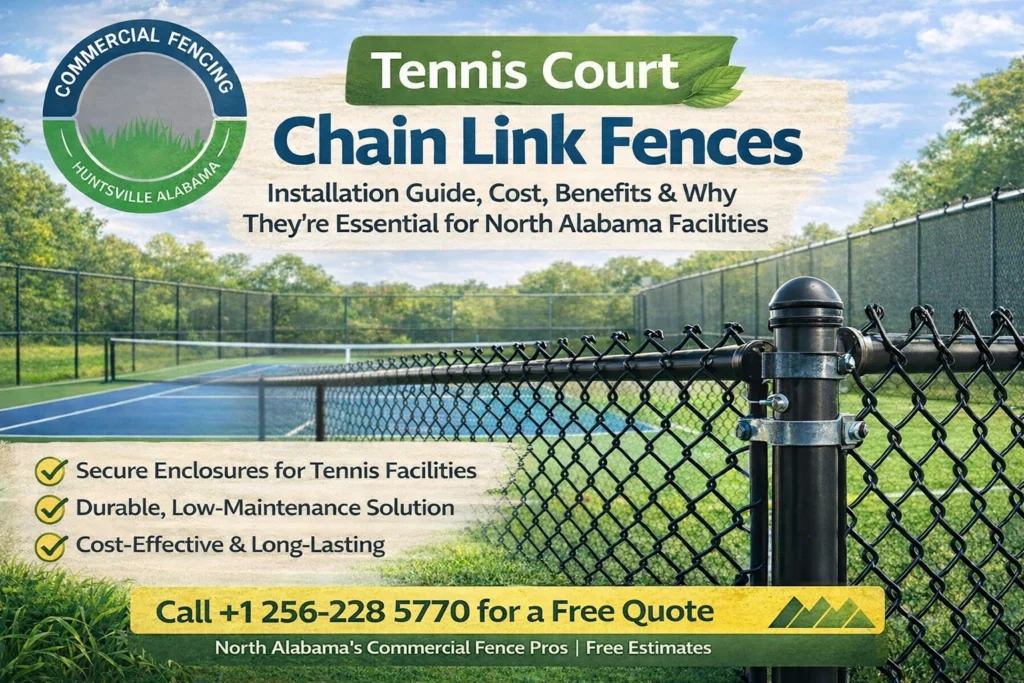
| A tennis court chain link fence uses 9-gauge wire, 1-3/4 inch mesh openings, stands 10 to 12 feet tall, and must meet ASTM F969 requirements. It is the industry-standard choice for residential, club, and commercial courts across North America. |
Chain link is the go-to fence for tennis courts for one simple reason. It works.
But not all chain link is equal. I have seen fences installed with the wrong gauge start sagging before the first full season ends. I have seen courts fail USTA inspection because someone bought 2-inch mesh instead of 1-3/4. Small decisions on the spec sheet turn into expensive problems on the court.
I have been installing tennis court fences across North Alabama for over three years. Huntsville, Madison, Athens, Decatur. Schools, recreation departments, private backyards. In that time I have answered the same questions hundreds of times.
This guide covers specs, real costs, honest trade-offs, and the mistakes I see buyers make most often. No filler. Just what you need to get the fence right.
Why Chain Link Is the Standard Choice for Tennis Court Fences
Walk up to almost any tennis court in North Alabama today, and you will find a chain link fence around it. That is not an accident.
Chain link dominates tennis court fencing because it gives players a clear view of the ball, holds up under daily wear without much upkeep, and costs far less than wood or ornamental steel. The open mesh creates a dark, neutral background that makes a yellow ball easy to track. Wood blocks that sightline. PVC panels muffle the sound cues players rely on. Chain link does neither.
The table below shows how the most common materials compare. Chain link wins on almost every column that matters for a court.
| Fence Material | Avg. Cost Per Linear Foot | Ball Visibility | Durability | Maintenance | Best For |
| Chain Link (Galvanized) | $8 to $18 | Excellent | High | Low | Budget courts |
| Vinyl-Coated Chain Link | $12 to $25 | Excellent | Very High | Low | Most courts |
| Welded Wire | $15 to $35 | Good | Very High | Low | High-traffic clubs |
| Vinyl / PVC | $20 to $45 | Good | High | Very Low | Residential luxury |
| Wood Frame | $30 to $65 | Poor | Moderate | High | Decorative only |
Chain link is the practical choice. Every other option asks you to give something up to get a different look.
Tennis Court Chain Link Fence Specifications (What ASTM F969 Actually Requires)
Most articles online tell you to buy 9-gauge chain link and leave it at that. Very few explain why, and almost none mention the industry standard that governs tennis court fencing specifically.
ASTM F969 is the ASTM International standard written for chain link fences around tennis courts. It defines the wire gauge, mesh size, post diameter, and structural requirements that a properly built court fence must meet. A fence built to this standard protects your investment and qualifies your court for USTA-sanctioned use. No other published blog covers this standard in plain English for a homeowner or facilities manager.
Below is every spec that ASTM F969 defines, written out in plain terms. Read the “Why It Matters” column. That is where most buyers go wrong.
| Specification | Standard Requirement | Why It Matters |
| Wire Gauge | 9 gauge recommended, 11 gauge minimum | Heavier gauge resists ball impact and lasts longer |
| Mesh Opening Size | 1-3/4 inch (not 2 inch) | Prevents ball penetration, keeps containment tight |
| Terminal Post Size | 3-inch diameter minimum | Corner and end posts carry the most load on the line |
| Line Post Size | 2-1/2 inch diameter | Spaced every 8 to 10 feet along the fence line |
| Top Rail | 1-5/8 inch diameter, Schedule 40 | Structural support across the full fence length |
| Post Embedment Depth | 3 feet minimum, 4 feet in soft soil | Prevents post lean over time |
| Standard Fence Height | 10 feet recreational, 12 feet competitive | Matches USTA court design guidelines |
| Governing Standard | ASTM F969 | The only ASTM standard written specifically for tennis court fencing |
On every job I run in North Alabama, these are the specs I build to. There is no good reason to cut corners on any of them.
| Not sure which height fits your court type? Read our full guide — How Tall Is a Tennis Court Fence? |
How Tall Should a Tennis Court Fence Be?
| QUICK ANSWER
The standard height for a tennis court chain link fence is 10 to 12 feet. Recreational and club courts use 10 feet as the minimum. Competition and tournament courts require 12 feet around the full perimeter, per USTA guidelines. |
Fence height is not the same at every point around the court. I split almost every court I build into zones. The back of the court needs the most height. The sides need less. A lot of buyers do not know this and end up overbuilding the sidelines and underbuilding the baselines.
| Court Zone | Recommended Height | Reason |
| Baseline areas (back of court) | 10 to 12 feet | High-speed shots exit at sharp angles here |
| Side court areas | 8 to 10 feet | Lower ball exit speeds on the sides |
| Net center area | 3 to 4 feet or open | Optional opening for spectator sightlines |
| Corners, California style | 10 to 12 feet | Diagonal panels stop balls from trapping in corners |
California corners, where the fence cuts diagonally across each corner instead of making a 90-degree turn, are worth the investment. They remove the dead zones where balls get stuck and slow every game down.
Here in Huntsville and across Madison County, any fence taller than 6 feet requires a building permit. Tennis court fences at 10 feet always need one. I file every permit myself so clients do not have to navigate that process.
| For complete height requirements by court type and North Alabama permit details, read our full guide — How Tall Is a Tennis Court Fence? |
How Much Does It Cost to Fence a Tennis Court?
| QUICK ANSWER
A tennis court fence costs between $4,500 and $12,000 installed for a standard doubles court in North Alabama. That works out to $12 to $35 per linear foot, depending on the material and height. |
A full doubles court perimeter runs approximately 300 to 340 linear feet when you include the run-off space around the playing surface. If a contractor quotes you based only on the playing surface itself, that number will come in low, and the final bill will surprise you.
| Chain Link Type | Material Cost Per Linear Foot | Full Court Estimate (Material Only) |
| 9 Gauge Galvanized | $8 to $18 | $2,400 to $6,120 |
| 11 Gauge Galvanized | $6 to $14 | $1,800 to $4,760 |
| 9 Gauge Black Vinyl-Coated | $12 to $25 | $3,600 to $8,500 |
| 11 Gauge Black Vinyl-Coated | $10 to $20 | $3,000 to $6,800 |
| 9 Gauge Green Vinyl-Coated | $12 to $25 | $3,600 to $8,500 |
Add $5 to $15 per linear foot for professional labor. That covers post setting, concrete work, fabric tension, and all hardware. Gates, windscreens, and permit fees are priced separately.
| For a complete breakdown of every cost line item, including labor, gates, windscreens, soil conditions, and North Alabama permit fees, read our full pricing guide — Tennis Court Fence Cost | 2026 Pricing Guide |
What Are the Disadvantages of a Chain Link Fence?
Chain link is the right call for most tennis courts. But I will not pretend it is perfect. These are the real drawbacks and what you can do about each one.
Fabric sag over time. A fence built with the wrong gauge or poor tension will sag within a few seasons. Nine-gauge wire, 8-foot post spacing, and proper fabric tension during installation prevent almost all of it.
Utilitarian appearance. Galvanized chain link has a plain silver look that some homeowners find too industrial. Black or green vinyl-coated chain link changes that. Add a windscreen on two sides, and the court looks finished.
Sharp edges at top and bottom. Standard chain link selvage can leave barbed points at the cut ends. Ask for a knuckle-knuckle finish on both edges. It removes the sharp points entirely and costs nothing extra.
No built-in privacy. Chain link is open mesh by design. A windscreen adds privacy without any structural change to the fence itself.
None of these is a deal-breaker. Chain link has been the standard for courts for decades because it works despite these trade-offs, not in spite of ignoring them. Know the fix before you build, and you will not deal with any of them.
5 Mistakes to Avoid When You Buy a Tennis Court Chain Link Fence
Last year alone, I got called to fix three court fences that were under two years old. Different contractors, different counties, same mistakes. Here is what keeps showing up.
Mistake 1. You went with an 11-gauge to cut costs on a high-use court. Eleven-gauge runs 20 to 30 percent less upfront. On a backyard court with casual weekly play, it holds up fine. On a school or club facility with daily use, it wears out fast. Nine-gauge pays for itself in five to seven years through fewer repairs and no early replacement.
Mistake 2. There is no mid-rail on the 12-foot fence. A 12-foot fence without a mid-rail will bow outward at the midpoint within one to two seasons from repeated ball impact. The mid-rail is not optional on tall fences. Put it in during the original build, not after the fact.
Mistake 3. The terminal posts are the wrong size. Corner posts, end posts, and gate posts bear far more tension load than line posts. They need 3-inch diameter posts. Undersized terminal posts are the most common cause of fence lean on older courts I get called to fix.
Mistake 4. Gate placement was an afterthought. Gate position affects post spacing across the entire fence line. Lock in your gate locations before the first post goes in the ground. Moving a gate after the posts are set means cutting and resetting concrete footings, which costs three times what it would have upfront.
Mistake 5. The windscreen went on after the fence was already built. Windscreens add real wind load to the fence structure. Standard 11-gauge fencing at 8-foot post spacing is not built for that load. The fence will lean. Plan your windscreen from day one so your gauge and post spacing account for it.
|
Serving Huntsville and North Alabama I install tennis court chain link fences across North Alabama, including Huntsville, Madison, Athens, Decatur, and the surrounding areas. Every fence we build is permitted, constructed to ASTM F969 specs, and posted at the correct depth for North Alabama soil conditions. Call us at +1 256-384-3619 – Monday through Friday, 9 AM to 5 PM. We are happy to walk you through options before you commit to anything. |
Final Thoughts
Get the specs right, and the rest falls into place. Nine-gauge, black vinyl-coated chain link built to ASTM F969 is the correct choice for most tennis courts in North Alabama. It is durable, low on upkeep, and built to handle the heat, humidity, and weather we deal with here.
Height and cost are the two questions I hear most often once a client understands the material. Both have clear answers once you know your court type and how it will be used.
| For full height requirements by court type, read — How Tall Is a Tennis Court Fence? |
| For a complete cost breakdown that includes labor, gates, windscreens, and permit fees, read — Tennis Court Fence Cost | 2026 Pricing Guide |
Get three quotes, specify 9-gauge, and you will have a fence that outlasts the court itself.
Frequently Asked Questions
Q1. What gauge chain link fence is best for a tennis court?
Nine gauge. That is the short answer. It handles ball impact better, lasts longer, and holds its tension across seasons. Eleven-gauge costs less upfront, somewhere around 20 to 30 percent less, depending on the supplier. On a backyard court with light use, 11 gauge is fine. On a school or club court that sees play every day, 11-gauge will cost you more in repairs within five years than you saved on materials.
Q2. What is the ASTM standard for tennis court fencing?
ASTM F969. It is the only ASTM standard written specifically for chain link fencing around tennis courts. It covers wire gauge, mesh opening size, post diameter, and how deep the posts need to go. If you are building a court for USTA-sanctioned play, your fence has to meet this standard. If a contractor has never heard of it, that is worth knowing before you sign anything.
Q3. Should I use galvanized or vinyl-coated chain link for a tennis court?
Vinyl-coated, black finish, almost every time. The reasons are practical. Black vinyl reduces glare behind the ball, which players notice immediately. It also resists rust in climates like North Alabama’s, where humidity eats through galvanized wire faster than most contractors will admit. Vinyl-coated adds $3 to $7 per linear foot over galvanized. On a 320-foot perimeter that is roughly $960 to $2,240 more. Spread over 25 years of fence life, that math is easy.
Q4. How high should a chain link fence be around a tennis court?
Ten feet for most courts. Twelve feet for competition and tournament play. Those are the USTA numbers, and they hold up in practice. The baseline ends of the court need the full height because balls exit at sharp angles there. The sides can step down to 8 or 10 feet on a recreational court without any real ball containment issue. If you are in Huntsville or anywhere in Madison County, anything over 6 feet needs a permit, regardless of height.
Q5. How much does a chain link fence cost for a tennis court?
Material alone runs $2,400 to $8,500 for a full doubles court perimeter, which is roughly 300 to 340 linear feet with proper run-off space included. Add $5 to $15 per linear foot for professional installation. All in, most courts in North Alabama come out between $4,000 and $13,500 installed. That range is wide because gauge, coating, height, gates, and windscreens all move the number. Get an itemized quote, not a single lump number, so you can see what you are actually paying for.
Q6. Can I add a windscreen to a chain link tennis court fence?
Yes, but the fence has to be built for it. Nine-gauge chain link at 8-foot post spacing handles windscreen load without issue. Eleven-gauge at 8-foot spacing does not. If you have 11-gauge and want to add a windscreen later, the post spacing needs to drop to 6 feet, which means pulling and resetting posts. That costs far more than planning for it upfront. If windscreens are anywhere in your plans, tell your contractor before the first post goes in.


