By: Commercial Fencing Huntsville | Licensed Fencing Contractor | Serving North Alabama | Call +1 256-384-3619 | Hours: Monday through Friday, 9 AM to 5 PM
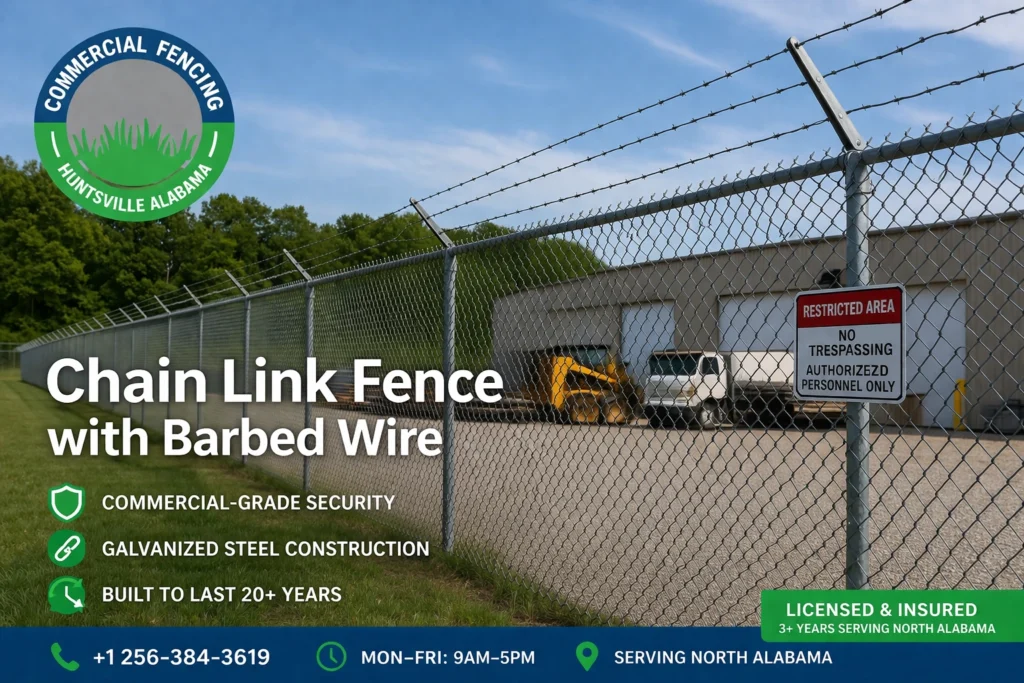
A chain link fence with barbed wire is a commercial-grade security barrier. It combines galvanized steel diamond-mesh fabric with two or three strands of barbed wire mounted on angled arms at the top of each post. The total height is typically 7 to 9 feet for most commercial properties. At Commercial Fencing Huntsville, we install this type of security fence for warehouses, industrial facilities, equipment yards, and utilities across North Alabama. Our business has served the region for over three years. Call us at +1 256-384-3619 for a free quote.
When a standard fence just does not cut it for your property, a chain link fence with barbed wire is the go-to answer. It is one of the most trusted forms of commercial security fencing in the country, and for good reason. It stops unauthorized access, withstands North Alabama weather, and holds up for decades without much maintenance.
I have seen the difference this type of fence makes for business owners across Huntsville, Madison, Decatur, and surrounding areas. A warehouse that once dealt with weekly equipment theft became a non-issue after we ran a proper 8-foot commercial chain link fence with a 3-strand barbed wire topper. That kind of result is why we do what we do.
This guide covers everything you need to know before you buy. You will find local pricing for Huntsville, Alabama-specific legal requirements, specs that match your property type, and a step-by-step look at how we install these fences from the first post to the last strand of wire. Read it start to finish or jump to the section you need most.
What Is a Chain Link Fence with Barbed Wire?
A chain link fence with barbed wire is made of two main parts. The first is the chain link fabric, which is a woven mesh of galvanized steel wire in a diamond pattern. The second is the barbed wire, which runs along the top of the fence on angled metal arms attached to each post.
Together, they create a fence that is hard to climb and tough to cut. The chain link fabric blocks entry at mid-height. The barbed wire at the top makes climbing over nearly impossible without serious injury. Add in the visual deterrent effect, and most trespassers will not even try.
This type of fence is not just for prisons or military sites. In North Alabama, we install it at warehouses, construction zones, utility substations, equipment storage yards, commercial parking lots, and school perimeters. Anywhere that needs a reliable, affordable security perimeter, this fence fits the bill.
The Chain Link Fabric
Chain link fabric is rated by wire gauge, which refers to the thickness of the steel wire used to weave the mesh. A lower gauge number means thicker, stronger wire. Here is how the gauges break down for commercial use:
- 11.5-gauge wire is the lightest option. It works for temporary fencing or light residential use, but it is not what we recommend for commercial security.
- 9-gauge wire is the most common choice for commercial properties in North Alabama. It is strong, affordable, and meets most commercial security needs.
- 6-gauge wire is the heaviest option. It is used for high-security industrial sites, correctional facilities, and any property where cutting resistance is a top concern.
The mesh size, which refers to the diamond openings in the fabric, also matters. A standard 2-inch by 2-inch mesh is common for commercial fencing. A tighter 1-inch by 1-inch mesh provides even more resistance to cutting and finger-hold climbing.
Most commercial chain link fabric is hot-dipped galvanized, which means it is coated in zinc to resist rust. For added durability, we also offer PVC-coated fabric in black, green, or brown. The coating adds 10 to 15 years of extra life to the fence in outdoor conditions like those we see in North Alabama.
The Barbed Wire
Barbed wire for fencing is made of two twisted steel strands with four-point barbs tied at regular intervals. The most common commercial specification is a 2-ply, 4-point galvanized wire with barbs spaced 4 to 5 inches apart. It must meet ASTM A121 standards for metallic-coated carbon steel barbed wire to qualify as commercial grade.
There are two main options for security wire toppers:
- Standard barbed wire. This is the traditional option. It uses sharp, twisted barbs to discourage climbing. It is the most common choice for warehouses, commercial yards, and equipment storage areas in Huntsville.
- Razor wire (concertina wire). This is a more aggressive option. It uses sharp-edged metal tape formed into coils, which can cause serious cuts on contact. It is typically reserved for high-security industrial sites, utilities, and correctional facilities. It costs more but provides a stronger deterrent.
For most of our clients in North Alabama, standard 3-strand barbed wire on a 9-gauge, 8-foot fence does the job well. We only recommend razor wire when the security risk level or regulatory requirement calls for it.
The Barbed Wire Arms
Barbed wire arms are metal extensions that bolt onto the top of each fence post. They hold the strands of barbed wire in place above the fence fabric. The angle and design of the arm changes the security level:
- 3-strand 45-degree outward-facing arm. This is the industry standard for commercial fencing. The arm extends outward from the secured area, making it harder to climb from the outside. It adds one foot of height to the total fence structure.
- 6-strand double-sided arm (Y-arm). This arm adds three strands on the inside and three on the outside. It is used for maximum security applications like correctional facilities, military sites, and recycling centers where climbing from either side is a concern.
- Vertical straight arm. This points straight up. It adds height and visual deterrence but is considered less effective than a 45-degree arm for preventing climbing.
The Chain Link Manufacturers Institute, known as the CLFMI, recommends the 3-strand 45-degree outward arm for most commercial perimeter security applications. That is the spec we default to for most of our North Alabama installations.
How Much Does a Chain Link Fence with Barbed Wire Cost in Huntsville, AL?
Cost is the first question almost every client asks me. I get it. You need to know what you are getting into before you call a contractor. So here is a straight answer based on what we see in the North Alabama market.
A professionally installed chain link fence with barbed wire in Huntsville, Alabama costs between $18 and $45 per linear foot, depending on the fence height, gauge, coating, and whether you add gates or upgrades. That price includes materials and labor.
Below is a detailed breakdown of what you can expect to pay for different configurations we install in this market:
| Fence Type | Height | Estimated Cost (Installed) | Best For |
| Chain Link + 3-Strand Barbed Wire | 6 ft + 1 ft arm | $18 – $26 per linear foot | Light commercial, parking lots |
| Chain Link + 3-Strand Barbed Wire | 8 ft + 1 ft arm | $22 – $32 per linear foot | Warehouses, equipment yards |
| Chain Link + 6-Strand Barbed Wire | 8 ft + 1 ft arm | $26 – $38 per linear foot | High-security industrial |
| Chain Link + Razor Wire Upgrade | 8 ft + 1 ft arm | $30 – $45 per linear foot | Utilities, restricted zones |
| Gate Addition (Single Swing) | Matching height | $400 – $900 per gate | Vehicle or pedestrian access |
| Gate Addition (Double Drive Gate) | Matching height | $900 – $2,000 per gate | Vehicle access, large openings |
Note: These price ranges reflect typical installed costs in the Huntsville, AL market as of 2025 to 2026. Prices vary based on terrain, soil conditions, total linear footage, and material availability. Contact us at +1 256-384-3619 for a free on-site estimate.
What Affects Your Final Price?
Several factors can push your quote higher or lower than the ranges above:
- Terrain and soil: Flat, open ground is cheapest to work with. Rocky soil, slopes, or ground with tree roots adds labor time and cost. Huntsville has its share of hilly terrain, and we price those jobs accordingly.
- Total linear footage: Longer fences cost less per foot because the fixed costs of mobilization, equipment, and setup get spread across more footage. A 500-foot run will cost less per foot than a 100-foot run.
- Wire gauge and coating: Upgrading from 9-gauge to 6-gauge commercial wire adds 15 to 30 percent to material costs. PVC coating adds another layer of cost but extends the lifespan significantly.
- Gate type and count: Gates are the most variable part of a fence project. A simple single-swing pedestrian gate costs $400 to $900 installed. An automated rolling gate for vehicle access can run $1,500 to $3,500 or more.
- Permit fees: The City of Huntsville and Madison County both require permits for commercial fence installations. Permit fees typically run $50 to $200 for commercial projects. We handle the permit process for all our clients.
- Old fence removal: If you have an existing fence that needs to come down first, expect to add $2 to $5 per linear foot for removal and disposal.
Is a Chain Link Fence with Barbed Wire Worth the Cost?
Yes, in most commercial situations it is. A properly installed 8-foot commercial chain link fence with barbed wire will last 20 to 30 years with minimal maintenance. Compare that to a wood privacy fence, which needs repainting or staining every 3 to 5 years and typically lasts 10 to 15 years before needing major repairs. The chain link option costs less upfront and far less over time.
For businesses that store heavy equipment, vehicles, or high-value inventory outside, the insurance savings and theft deterrence alone often pay for the fence within two to three years. That is the conversation I have with most of my commercial clients, and the math usually works out clearly in favor of chain link with barbed wire.
Is Barbed Wire on a Chain Link Fence Legal in Huntsville, Alabama?
This is a question I get on almost every commercial fencing job. The short answer is yes, barbed wire is legal in commercial and industrial zones in Huntsville, Alabama, with some conditions. But the rules matter, and skipping this step can get your fence flagged for removal.
Alabama State Fence Law
Alabama state law under Title 35 of the Code of Alabama does not broadly prohibit barbed wire fencing. The state’s primary fence statutes focus on agricultural uses, livestock, and property line disputes. There is no blanket state law that prohibits barbed wire on commercial property in Alabama.
That means the rules at the local level, specifically Huntsville’s city code and Madison County zoning ordinances, govern what you can and cannot install.
Huntsville City Zoning Rules for Barbed Wire
In Huntsville, barbed wire fencing is generally permitted in industrial and heavy commercial zoning districts, which are typically classified as M-1, M-2, or Industrial zones under the Huntsville Unified Development Code. These are the zones where most of our clients operate, including manufacturing plants, distribution centers, equipment yards, and utility facilities.
In standard commercial zones, barbed wire is typically allowed on top of a fence that is already at least 6 feet tall. The barbed wire must be mounted above the fence fabric, not embedded in it. Most municipalities in North Alabama follow the general standard that barbed wire must be mounted at least 6 to 7 feet above finished grade to keep it out of reach of pedestrians.
Barbed wire is generally not allowed in residential zones, school front yards, or within a specified setback distance from public sidewalks. If your property is near a residential area or a public street, we will check the specific setback rules before we design your fence.
Do You Need a Permit for a Barbed Wire Fence in Huntsville?
Yes. Any commercial fence installation in Huntsville that exceeds a certain height, or that includes security wire, requires a building permit from the City of Huntsville Building Department. The permit process involves submitting a site plan that shows the fence location, height, and materials.
We handle the permit application for every commercial job we take on. That means you do not have to navigate city hall on your own. We know what the inspectors look for, and we design every fence to pass inspection the first time.
Before we break ground, we also call 811 to mark underground utilities. This is not optional. It is the law in Alabama, and it protects your property and our crew.
What About HOA Restrictions?
If your commercial property is inside a development with a homeowners association or commercial property association, there may be additional rules on fence materials and appearance. We recommend confirming with your association before signing any contract. We are happy to review any association guidelines and design a fence that meets both HOA requirements and your security needs.
Chain Link Fence with Barbed Wire Specifications for Commercial Properties
Not all chain link fences are built the same. A residential fence from a big-box hardware store and a commercial-grade security fence look similar from the road, but they are very different when it comes to material strength, post depth, and long-term performance. Here is what a proper commercial chain link fence with barbed wire looks like from a specifications standpoint.
| Component | Residential Grade | Commercial Grade | Industrial / High-Security |
| Wire Gauge | 11.5 gauge | 9 gauge | 6 gauge |
| Mesh Size | 2″ x 2″ | 2″ x 2″ | 1″ x 1″ |
| Coating | Galvanized (Class 1) | Hot-dipped galvanized | Hot-dipped + PVC coated |
| Post Diameter | 1-5/8″ | 2″ or 2-3/8″ | 2-7/8″ to 4″ |
| Post Spacing | Up to 10 ft apart | 8 to 10 ft apart | 8 ft or less |
| Post Depth | 2 ft concrete footing | 2.5 ft concrete footing | 3 ft concrete footing |
| Barbed Wire Strands | Not typical | 3-strand arm | 6-strand arm |
| Arm Angle | N/A | 45 degrees outward | 45 degrees, double-sided |
| Total Height (fabric + arm) | 4 to 6 ft | 7 to 9 ft | 10 to 12 ft |
| Expected Lifespan | 10 to 15 years | 20 to 30 years | 30+ years |
Source: Specifications based on CLFMI (Chain Link Manufacturers Institute) commercial and industrial fence guidelines, ASTM F567 installation standards, and ASTM A392 fabric specifications.
Why Commercial Specs Matter
The difference between a 9-gauge fence and an 11.5-gauge fence is not just thickness. It is the fence’s ability to resist cutting tools, vehicle impact, and long-term weather wear. We have seen budget fences installed by cut-rate contractors that needed major repairs within three years. That is not a situation any business owner wants to deal with.
For most of our commercial clients in Huntsville, we recommend 9-gauge hot-dipped galvanized fabric on a commercial HF20 framework with 2-inch or 2-3/8-inch line posts set in concrete. That combination gives you a fence that will hold up in North Alabama conditions for at minimum 20 years.
For high-security or industrial clients, such as those near Redstone Arsenal, aerospace suppliers, and heavy manufacturing operations, we step up to 6-gauge fabric on HF40 industrial framework with larger post diameters. The upgrade is worth it when the value of what is inside the fence justifies the higher upfront cost.
Where Do Businesses in North Alabama Use Chain Link Fencing with Barbed Wire?
Over three years in this business, I have installed these fences at a wide range of properties across North Alabama. Each one had different security needs, but the solution was similar: a strong commercial chain link fence with the right barbed wire configuration for the job. Here are the most common applications we see in this market.
Warehouses and Distribution Centers
Warehouses store high-value inventory and often operate with large open parking lots and loading areas. A chain link fence with barbed wire around the perimeter keeps vehicles and unauthorized visitors out of restricted areas while still allowing security staff to see the entire property at a glance. We typically install 8-foot fencing with 3-strand barbed wire arms on these jobs, along with automated drive gates for truck access.
Manufacturing Plants and Industrial Facilities
North Alabama has a strong manufacturing base, with auto parts suppliers, aerospace components manufacturers, and heavy industrial operations spread across Madison County and the surrounding area. These facilities need perimeter fencing that meets OSHA safety standards, deters theft of materials and equipment, and keeps unauthorized personnel away from hazardous work zones. We install 6-gauge commercial fencing with full security specifications for industrial clients.
Construction Site Security Fencing
Construction sites are prime targets for equipment theft. A portable chain link fence is useful for temporary setups, but many long-term construction projects need a permanent or semi-permanent chain link fence with barbed wire to protect excavators, generators, and stored materials overnight and on weekends. We offer both temporary and permanent installations depending on the project timeline.
Utility Infrastructure
Electrical substations, water treatment facilities, natural gas installations, and communications towers all require secure perimeter fencing. In many cases, federal or state regulations mandate a minimum fence height and security wire configuration for these facilities. We have worked with utility clients to design fences that meet regulatory requirements while staying within budget. ASTM standards and CLFMI guidelines are the baseline for all utility fencing we install.
Equipment and Vehicle Storage Yards
Heavy equipment, commercial vehicles, trailers, and fleet vehicles represent a major capital investment. Outdoor storage yards are exposed overnight and on weekends when staff are not on site. A chain link fence with barbed wire is one of the most cost-effective ways to protect that investment. We often pair these installations with automated gate operators and keypad or card-reader access control systems.
School and Government Facility Perimeters
Schools, government buildings, and public facilities in North Alabama often need perimeter fencing that balances security with public accessibility. For school athletic fields and back perimeters, chain link with standard barbed wire is a practical solution. Front entries and pedestrian areas require a different approach, and we design each project to match the specific needs and any applicable regulations for public facilities.
Barbed Wire vs. Razor Wire on a Chain Link Fence
One of the most common questions I get from commercial clients is whether they should go with standard barbed wire or upgrade to razor wire. The answer depends on your security level, your zoning district, and your budget. Here is an honest comparison.
Standard Barbed Wire
Standard barbed wire uses two twisted galvanized steel strands with sharp four-point barbs crimped at regular intervals. When you touch it, it punctures and scratches. It is not designed to shred. For most commercial properties in North Alabama, this level of deterrence is more than enough. It keeps out opportunistic trespassers, deters casual climbing, and sends a clear visual message that the area is restricted.
Three strands of standard barbed wire on a 45-degree outward arm is what we install on the large majority of our commercial projects. It is legal in commercial and industrial zones across Huntsville and surrounding areas, and it is the most cost-effective security upgrade you can make to a chain link fence.
Razor Wire (Concertina Wire)
Razor wire, also called concertina wire or barbed tape obstacle, is a more aggressive security measure. It consists of sharp metal tape formed into coils or flat panels. Contact with razor wire causes serious lacerations. It is used where the security risk is significantly higher, such as correctional facilities, military installations, power generation plants, and high-value material storage.
In Huntsville’s zoning code, razor wire is permitted in the same zones as standard barbed wire, but we always double-check specific site requirements before specifying it. Because of the serious injury potential, property owners who use razor wire should post clear warning signs and confirm with their liability insurance carrier that the installation is covered.
Razor wire adds $3 to $7 per linear foot to the cost of a standard barbed wire installation. For most warehouses and commercial yards, that upgrade is not necessary. For utilities, industrial plants, and any site where a determined intruder could cause significant damage or injury to themselves or others, the upgrade is worth considering.
Which One Is Right for Your Property?
Here is the simple way I explain it to clients. If your biggest concern is stopping casual trespassers and deterring theft of equipment or inventory, standard 3-strand barbed wire does the job. If you have a facility where unauthorized entry could result in catastrophic theft, sabotage, or serious safety hazards, razor wire may be the right choice.
Call us at +1 256-384-3619 and describe your property and security concerns. We will give you a straight recommendation based on what we actually see at similar facilities in North Alabama, not just what costs more.
How We Install Chain Link Fencing with Barbed Wire in Huntsville
Understanding the installation process helps you know what to expect when you hire us, and why professional installation matters for a fence that needs to perform under real security conditions. Here is how we work through a commercial chain link fence project from start to finish.
Step 1. Site Assessment and Permits
Every job starts with a site visit. I walk the property line with the client, take measurements, identify any grade changes or obstacles, and talk through what the fence needs to accomplish. After the visit, we put together a written estimate with a clear scope of work and materials list.
Before any digging happens, we submit the permit application to the City of Huntsville Building Department and call 811 to mark underground utilities. Every contractor is legally required to do this in Alabama. Anyone who skips this step is cutting corners in a way that can damage your utilities and put their crew at risk.
Step 2. Setting Posts in Concrete
The posts are the backbone of the fence. We use schedule 40 steel pipe for commercial jobs, or schedule 80 for heavy industrial installations. Line posts are spaced no more than 10 feet apart, and terminal posts (end, corner, and gate posts) are set with concrete footings that go at minimum 2.5 feet deep for a commercial fence.
The concrete must cure fully before we hang the fabric. We typically set posts on day one and return on day two or later to continue the installation. Rushing the curing process leads to posts that shift under tension and fences that sag within a year or two.
Step 3. Installing the Top Rail and Tension Wire
The top rail runs through the loop caps on each line post and connects to the terminal posts with rail ends and brace bands. It gives the fence its horizontal rigidity and serves as the attachment point for the barbed wire arms.
The tension wire runs along the bottom of the fence, about 4 inches above the ground. It keeps the bottom of the fabric from bowing outward and prevents animals or small children from pushing under the fence. For high-security applications, we also run a tension wire at mid-height.
Step 4. Hanging and Stretching the Chain Link Fabric
The chain link fabric is unrolled along the fence line and attached to the terminal post with tension bars. We then stretch it tight across the line posts using a come-along puller or fence stretcher. Proper tension is critical. A fence that is too loose sags and provides easy handholds for climbing. A fence that is over-tensioned can distort the mesh and damage the posts.
The fabric is secured to line posts with aluminum wire ties and to the top rail with standard ties. Every connection point is important. Loose ties mean a fence that rattles, sags, and eventually fails at those points.
Step 5. Attaching Barbed Wire Arms and Running Wire Strands
Once the fabric is set, we bolt the barbed wire arms to the top of each post. The arms angle outward at 45 degrees from the secured side. We then run three strands of galvanized barbed wire through the slots in the arms, pulling each strand tight before securing it with lock wire at each arm.
Safety matters here. Our crew wears heavy-duty gloves, long sleeves, and eye protection when working with barbed wire. If you are considering a DIY installation of the barbed wire portion, please take this seriously. A slip while pulling wire under tension can cause a deep cut that needs stitches. This is work that benefits from experience and the right tools.
Step 6. Gate Installation and Final Inspection
Gates go in last. Single-swing gates use heavy-duty hinges and a fork latch or padlock hasp. Double drive gates are set with a cane bolt on one side and hinges on the other. If you have asked for an automated gate operator, we wire and program the operator at this stage.
Before we leave the job, we walk the entire fence line with you. We check tension, tie connections, gate swing and latch, and barbed wire alignment. We also confirm that the installation meets the specs on the permit. Our goal is a fence that passes city inspection on the first visit.
Why Huntsville Businesses Choose Commercial Fencing Huntsville
There are other fencing contractors in North Alabama. I know that. So let me tell you plainly why clients call us and keep calling us.
We Know Huntsville’s Rules
We have navigated Huntsville’s permitting office, reviewed Madison County zoning maps, and designed fences for properties in multiple districts across North Alabama. We know which zones allow barbed wire, which require special setbacks, and what the building inspectors look for on commercial fence projects. That knowledge saves you time, money, and the headache of a failed inspection.
We Use Commercial-Grade Materials
We do not install residential-grade products on commercial jobs. Every commercial fence we build uses ASTM-compliant galvanized steel fabric, schedule 40 or 80 steel posts, and hot-dipped galvanized hardware throughout. We spec our fences to meet or exceed CLFMI commercial installation standards because that is what lasts 20 to 30 years without major repairs.
We Have Done This Work Across North Alabama
Over three years in business, we have installed chain link fencing with barbed wire at manufacturing facilities, distribution warehouses, construction sites, utility installations, and commercial storage yards across Huntsville, Madison, Decatur, Athens, and surrounding communities. We bring real field experience to every project.
We Back Our Work
We stand behind every fence we install. If something is wrong with our workmanship, we come back and fix it. That is not a common guarantee in this industry, and we think it should be.
Chain Link Fence with Barbed Wire: Frequently Asked Questions
How many strands of barbed wire go on top of a chain link fence?
The standard for commercial chain link fencing is three strands of barbed wire mounted on 45-degree outward-facing arms. For higher security industrial applications, six strands on a double-sided Y-arm is common. Three strands add approximately one foot to the total height of the fence and meet the CLFMI commercial security fence recommendations for most business properties.
Is barbed wire on a chain link fence legal in Huntsville, Alabama?
Yes, barbed wire on a chain link fence is legal in commercial and industrial zoning districts in Huntsville, Alabama. It is generally permitted in M-1, M-2, and Industrial zones when mounted at the top of a fence that is already at least 6 feet tall. It is not permitted in residential zones. A permit is required for all commercial fence installations. We handle permits for every job we take on.
How much does it cost to add barbed wire to a chain link fence in Huntsville?
Adding three strands of barbed wire to an existing chain link fence in Huntsville, Alabama typically costs $3 to $6 per linear foot for materials and labor, depending on the existing post condition and height. If you are installing a new fence with barbed wire, expect $18 to $32 per linear foot installed for a standard 6 to 8-foot commercial fence. Call +1 256-384-3619 for a free site estimate.
What height fence is required before you can add barbed wire?
In most commercial and industrial zones, the fence must be at least 6 feet tall before barbed wire is permitted on top. The barbed wire arms then add another 12 inches, bringing the total height to 7 feet or more. For most commercial security applications, we recommend starting with a 7-foot fabric height plus a 1-foot barbed wire arm for a total of 8 feet. The industry standard for secure commercial storage is 8 feet total.
What is the difference between barbed wire and razor wire on a chain link fence?
Standard barbed wire uses two twisted steel strands with sharp four-point barbs. It punctures and scratches on contact. Razor wire, also called concertina wire, uses sharp steel tape formed into coils that cause serious lacerations. Barbed wire is the standard choice for most commercial properties. Razor wire is reserved for high-security industrial sites, utilities, and correctional facilities. Razor wire costs $3 to $7 more per linear foot than standard barbed wire.
How long does a chain link fence with barbed wire last?
A commercial-grade chain link fence with barbed wire, installed with hot-dipped galvanized fabric and proper concrete post footings, lasts 20 to 30 years with minimal maintenance. PVC-coated fabric can extend that lifespan to 30 years or more. Annual inspections to check tension, tie connections, and rust spots will keep your fence performing at full strength throughout its lifespan.
Can I install barbed wire on a chain link fence myself?
Technically yes, but it carries real risk. Barbed wire under tension can snap back with force and cause deep lacerations. It requires heavy-duty gloves, full protective clothing, eye protection, and the right tensioning tools. Beyond personal safety, improper installation can produce a fence that fails at the arms or sags within a year. For any commercial property, professional installation is the better investment. Call us at +1 256-384-3619.
What wire gauge is best for commercial security fencing in North Alabama?
For most commercial properties in Huntsville and North Alabama, 9-gauge hot-dipped galvanized chain link fabric on a commercial HF20 framework is the right starting point. It balances strength, durability, and cost for warehouses, equipment yards, and standard commercial perimeters. For higher security industrial applications where cutting resistance is critical, 6-gauge fabric on HF40 framework is the professional standard.
Do I need a permit for a commercial barbed wire fence in Huntsville, AL?
Yes. A building permit is required for all commercial fence installations in Huntsville, Alabama, including fences with barbed wire. The permit requires a site plan showing the fence location, height, and materials. Commercial Fencing Huntsville handles the permit application process for every job. Permit fees for commercial fencing in Huntsville typically range from $50 to $200 depending on the project scope.
What is a barbed wire arm on a chain link fence?
A barbed wire arm is a metal extension bracket that bolts to the top of each fence post. It holds the strands of barbed wire above the fence fabric at an angle. The standard configuration is a 45-degree outward-facing arm that holds three strands of barbed wire. The arm is included in the fence’s total height measurement and adds approximately 12 inches of height and security above the chain link fabric.
Our Service Area in North Alabama
Commercial Fencing Huntsville installs chain link fencing with barbed wire throughout North Alabama. Our primary service area includes:
- Huntsville, AL (35801, 35802, 35803, 35805, 35806, 35810, 35811, 35816)
- Madison, AL
- Decatur, AL
- Athens, AL
- Hartselle, AL
- Scottsboro, AL
- Guntersville, AL
- Florence, AL
- Cullman, AL
If your property is in North Alabama and you do not see your city listed, call us at +1 256-384-3619. We serve a wide area and can likely accommodate your project.
Get a Free Quote on Chain Link Fence with Barbed Wire in Huntsville, AL
You now have everything you need to make a smart decision about your commercial fencing project. If you are ready to move forward, or you just want to talk through your options with someone who has installed these fences across North Alabama, give us a call.
Commercial Fencing Huntsville is available Monday through Friday, 9 AM to 5 PM. We offer free on-site estimates with no obligation. We handle permits, site assessment, material sourcing, installation, and final inspection.
Call us today at +1 256-384-3619
Monday to Friday, 9 AM to 5 PM | Serving North Alabama
Huntsville, AL 35805 | Licensed and Insured | 3+ Years Serving North Alabama
About the Author
This article was written by the owner and lead installer at Commercial Fencing Huntsville, a licensed and insured fencing contractor based in Huntsville, AL 35805. With over three years of hands-on experience installing commercial chain link fencing with barbed wire across North Alabama, the author draws from real project experience, CLFMI guidelines, ASTM standards, and direct knowledge of Huntsville’s local zoning and permit requirements.